CRIMINAL INTELLIGENCE. NCAT. THE DOCUMENTED RECORD
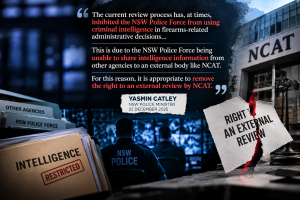
On 22 December 2025, NSW Police Minister Yasmin Catley justified abolishing independent NCAT review of firearms licensing decisions by claiming that the existing process inhibited police from using criminal intelligence.
But the published tribunal record tells a different story. NSW Police had already used criminal intelligence in firearms licensing matters, and NCAT had considered confidential intelligence in reviewing those decisions.
The cases listed below document that practice and raise serious questions about the Minister’s justification. If criminal intelligence was already being used and considered, why was abolishing independent review necessary?
If confidential intelligence could be handled within the tribunal system, what specific barrier required the removal of independent review rights?
Tribunal case library
Browse a selected set of published tribunal decisions classified by the research dataset as involving criminal intelligence in firearms-related matters. Classification is research-derived and does not independently establish what evidence was admitted in each proceeding.
76 verified and approved cases
Addison v Commissioner of Police, NSW Police Force [2019] NSWCATAD 99
2019-05-31 Outcome not classified NSW Police Force
Closed hearing recorded
View case details
Outcome
What the Tribunal decided and orders made
Firearms prohibition order affirmed; confidentiality restrictions imposed.
Orders
- The decision under review is affirmed.
- Under sections 64(1)(c) and (d) of the Civil and Administrative Tribunal Act 2013 (NSW), the transcript and recording of the confidential hearing, all confidential material placed before the Tribunal and the contents of paragraphs marked “[Not for publication]” must not be published or released to the applicant.
Protected information
How confidential or protected intelligence was used
The Commissioner tendered confidential criminal information or intelligence reports. The Tribunal determined that section 75(5) of the Firearms Act required it to receive evidence and hear argument in the absence of the public, applicant and applicant’s representatives. The confidential hearing was conducted accordingly. The Tribunal restricted publication and disclosure of the confidential hearing record, evidence and protected paragraphs under section 64. It expressly gave some weight to the confidential information in affirming the FPO. Protected contents are not reproduced or inferred.
Mechanisms employed
- Closed hearing
- Applicant excluded
- Legal representative excluded
- Public excluded
- Non-publication order
- Non-disclosure / restricted disclosure
- Confidential evidence received
- Confidential evidence considered
- Confidential evidence relied upon
Legal framework
Legislation and statutory mechanisms
Firearms Act 1996 (NSW), ss 3, 73(1), 74A, 75(5) — public safety, firearms prohibition orders, search powers and mandatory confidential handling of specified criminal intelligence. Civil and Administrative Tribunal Act 2013 (NSW), s 64(1)(c)–(d) — non-publication and restricted disclosure. Administrative Decisions Review Act 1997 (NSW), s 63 — correct and preferable decision on merits review. Crimes (Criminal Organisations Control) Act 2012 (NSW) — contextual criminal organisation legislation.
AI-assisted editorial summary. Refer to the official decision for authoritative reasons and orders.
Ainscough v Commissioner of Police, New South Wales Police Force [2021] NSWCATAD 47
2021-03-03 Outcome not classified Commissioner of Police, New South Wales Police Force
Closed hearing recorded
View case details
Outcome
What the Tribunal decided and orders made
Five interlocutory confidentiality orders granted; Category AB licence refusal merits not determined.
Orders
- Under section 49 of the Civil and Administrative Tribunal Act 2013 (NSW), the substantive hearing, insofar as it concerns Confidential Material described in the Confidential Statement, is to be conducted without the applicant, the applicant’s legal representatives and the public.
- Under section 59 of the Administrative Decisions Review Act 1997 (NSW), the Commissioner need not lodge copies of the documents or parts of documents specified in the Confidential Statement and supplied as confidential exhibit CR2.
- Under section 64(1)(c) of the NCAT Act, publication of the Confidential Material, confidential exhibit CR2 and matters contained in them is prohibited.
- Under section 64(1)(d) of the NCAT Act, disclosure of that material and its contents is restricted to the Commissioner, the Commissioner’s legal representatives and the Tribunal.
- Under sections 64(1)(b)–(d) of the NCAT Act, publication and recording of the confidential preliminary hearing, including exhibit CR2 and evidence given during it, are prohibited; paragraphs marked “[Not for publication]” must not be published or released to the applicant.
Protected information
How confidential or protected intelligence was used
The Commissioner made an ex parte application to protect confidential police intelligence and confidential exhibit CR2. The Tribunal received and examined protected material, together with open evidence concerning the risks of disclosure. It concluded that publication could expose informants, reveal police methodology, undermine investigations or create risks of reprisal. The Tribunal ordered a future private substantive hearing on protected material without the applicant, legal representatives or public, exempted the Commissioner from lodging specified copies and restricted publication and disclosure. It expressly assumed the evidence for the limited purpose of deciding confidentiality; it did not make a substantive licensing determination or decide the truth of the intelligence.
Mechanisms employed
- Closed hearing
- Applicant excluded
- Legal representative excluded
- Public excluded
- Non-publication order
- Non-disclosure / restricted disclosure
- Exemption from lodging confidential copies
- Confidential evidence received
- Confidential evidence considered
Legal framework
Legislation and statutory mechanisms
Firearms Act 1996 (NSW) — underlying Category AB licence refusal. Administrative Decisions Review Act 1997 (NSW), ss 58–59 — document lodgement and exemptions. Civil and Administrative Tribunal Act 2013 (NSW), ss 49(1)–(2), 64(1)(b)–(d) — open justice, private hearings, non-publication and restricted disclosure. Authorities include State of New South Wales (Justice Health) v Dezfouli [2018] NSWADTAP 69, Simring v Commissioner of Police [2009] NSWSC 270 and Grant v Commissioner of Police [2020] NSWCATAD 158.
AI-assisted editorial summary. Refer to the official decision for authoritative reasons and orders.
Angwin v Commissioner of Police [2022] NSWCATAD 161
2022-05-20 Outcome not classified NSW Police Force
Closed hearing recorded
View case details
Outcome
What the Tribunal decided and orders made
Interlocutory confidentiality application granted; merits of firearms licence refusal reserved.
Orders
- Under section 49 of the Civil and Administrative Tribunal Act 2013 (NSW), the substantive hearing, insofar as it concerns the Confidential Material described in the Confidential Statement, is to take place without the applicant, the applicant’s legal representatives and the public.
- Under section 59 of the Administrative Decisions Review Act 1997 (NSW), the Commissioner is exempt from lodging copies of the Confidential Material specified in the Confidential Statement and confidential exhibit CR3.
- Under section 64(1)(c) of the Civil and Administrative Tribunal Act 2013 (NSW), publication of the Confidential Material and confidential exhibit CR3, and matters contained in them, is prohibited.
- Under section 64(1)(d), disclosure of the Confidential Material and confidential exhibit CR3, and matters contained in them, is restricted to the Commissioner, the Commissioner’s legal representatives and the Tribunal.
- Under sections 64(1)(b)–(d), publication and recording of the confidential preliminary hearing, including exhibit CR3 and evidence given, is prohibited; paragraphs marked not for publication must not be published or released to the applicant.
Protected information
How confidential or protected intelligence was used
The Tribunal considered a confidential statement, confidential exhibit CR3 and evidence in support of the Commissioner’s application. It ordered closed-hearing arrangements for the protected part of the future substantive hearing, exclusion of the applicant, legal representatives and public, exemption from lodging specified confidential copies, and restrictions on publication, recording and disclosure. The Tribunal expressly did not determine credibility or evidentiary weight at this stage. The later substantive decision [2022] NSWCATAD 346 must be assessed separately for whether the Tribunal relied upon the protected evidence.
Mechanisms employed
- Closed hearing
- Applicant excluded
- Legal representative excluded
- Public excluded
- Non-publication order
- Non-disclosure / restricted disclosure
- Exemption from lodging confidential copies
- Confidential evidence received
- Confidential evidence considered
Legal framework
Legislation and statutory mechanisms
Civil and Administrative Tribunal Act 2013 (NSW), ss 49, 64(1)(b)–(d); Administrative Decisions Review Act 1997 (NSW), ss 58, 59; Firearms Act 1996 (NSW), ss 11, 75. Related substantive decision: [2022] NSWCATAD 346.
AI-assisted editorial summary. Refer to the official decision for authoritative reasons and orders.
Angwin v Commissioner of Police, New South Wales Police Force (No 2) [2022] NSWCATAD 346
2022-10-28 Outcome not classified Commissioner of Police, New South Wales Police Force
No closed-hearing flag in this dataset
View case details
Outcome
What the Tribunal decided and orders made
Affirmed the decision under review
Orders
- The decision to refuse the Applicant’s Category AB Firearms Licence is affirmed.
Protected information
How confidential or protected intelligence was used
The Tribunal considered confidential police evidence under s49 and s64 NCAT Act and s59 ADR Act. The applicant was excluded from accessing this material and could not challenge it. The Tribunal acknowledged the procedural unfairness but gave weight to the confidential evidence, which contributed to the decision to refuse the firearms licence. A suppression order under s64 prevented publication of.
Legal framework
Legislation and statutory mechanisms
- Firearms Act 1996 (NSW) - ss 11(3)(a), 11(7), 75
- Administrative Decisions Review Act 1997 (NSW) - s 63
- Civil and Administrative Tribunal Act 2013 (NSW) - ss 49, 64
AI-assisted editorial summary. Refer to the official decision for authoritative reasons and orders.
Aubrey v Commissioner of Police [2005] NSWADT 266
2005-11-23 Outcome not classified Commissioner of Police, New South Wales Police
Closed hearing recorded
View case details
Outcome
What the Tribunal decided and orders made
Firearms licence revocation affirmed.
Orders
- The decision under review is affirmed.
Protected information
How confidential or protected intelligence was used
The Commissioner relied on a confidential affidavit from a member of the public who expressed fear for their safety. On 3 August 2005 the Tribunal heard that witness in the absence of the applicant and the applicant’s legal representative. The published judgment does not expressly say the public was excluded, nor does it reproduce a separate non-publication order. The applicant had no opportunity to challenge or respond to that evidence. The Tribunal acknowledged this procedural disadvantage but expressly considered and relied on the confidential account, stating it highlighted the applicant’s lack of control when frustrated. The public judgment does not disclose the witness’s identity or protected evidence in detail.
Mechanisms employed
- Closed hearing
- Applicant excluded
- Legal representative excluded
- Confidential evidence received
- Confidential evidence considered
- Confidential evidence relied upon
Legal framework
Legislation and statutory mechanisms
Firearms Act 1996 (NSW), ss 3 and 24(2)(b) — public safety, responsible firearm control and revocation. Firearms (General) Regulation 1997 (NSW), cl 17 — revocation where continuation is contrary to the public interest. Administrative Decisions Tribunal Act 1997 (NSW) — procedural framework for the confidential witness hearing; the published judgment does not specify the provision for the exclusion.
AI-assisted editorial summary. Refer to the official decision for authoritative reasons and orders.
Avnell v Commissioner for Fair Trading [2018] NSWCATAD 58
2018-03-16 Outcome not classified Commissioner for Fair Trading; Commissioner of Police
Closed hearing recorded
View case details
Outcome
What the Tribunal decided and orders made
Tattooist licence refusal set aside; licence granted.
Orders
- The decision under review is set aside.
- In substitution for the decision under review, the applicant’s application for a tattooist licence is granted.
Protected information
How confidential or protected intelligence was used
The respondents submitted confidential police material in connection with an adverse security determination. A confidential hearing took place on 26 February 2018. A section 64(1)(b), (c) and (d) publication restriction covered the hearing recording and transcript, confidential exhibit RC1 and paragraphs marked “[NOT FOR PUBLICATION]”, barring publication or disclosure to the public or applicant. The Tribunal received and considered the confidential material but nonetheless found in favour of the applicant. The public reasons do not establish that protected material was relied upon to reach an adverse determination. The precise attendance arrangements for legal representatives are not established in the publicly quoted restriction.
Mechanisms employed
- Closed hearing
- Public excluded
- Non-publication order
- Non-disclosure / restricted disclosure
- Confidential evidence received
- Confidential evidence considered
Legal framework
Legislation and statutory mechanisms
Tattoo Parlours Act 2012 (NSW) — tattooist licensing, fitness and propriety, adverse security determinations and public interest. Civil and Administrative Tribunal Act 2013 (NSW), ss 49 and 64(1)(b)–(d) — confidential hearing and non-publication/non-disclosure. Administrative Decisions Review Act 1997 (NSW), s 63 — merits review.
AI-assisted editorial summary. Refer to the official decision for authoritative reasons and orders.
Ayshan v Commissioner of Police, New South Wales Police Force [2023] NSWCATAD 174
2023-07-04 Outcome not classified NSW Police Force
Closed hearing recorded
View case details
Outcome
What the Tribunal decided and orders made
Affirmed decision
Orders
- Time to lodge the administrative review is extended pursuant to s 41 of the Civil and Administrative Tribunal Act 2013 (the NCAT Act), until 31 January 2022.
- The decision to refuse the Applicantâs Category AB Firearms Licence application is affirmed.
- Pursuant to s 49 of the NCAT Act, the hearing of the application in the substantive proceedings be conducted in the absence of the applicant in the substantive proceedings, the legal representatives for the applicant in the substantive proceedings, and the public, insofar as it relates to the Confidential Material described in the Confidential Statement.
- Pursuant to s 64(1)(c) of the NCAT Act, the publication of the Confidential Material and confidential exhibit CR1, or matters contained in the Confidential Material and confidential exhibit CR1 is prohibited.
- Pursuant to s 64(1)(d) of the NCAT Act, the disclosure of the Confidential Material and confidential exhibit CR1, or matters contained in the Confidential Material and confidential exhibit CR1, is restricted to the Commissioner, the legal representatives for the Commissioner and the Tribunal.
- Pursuant to ss 64(1)(b), 64(1)(c) and 64(1)(d) of the NCAT Act, the publication and recording of the confidential hearing of these preliminary proceedings, including confidential exhibit CR1 and any evidence given during the confidential portion of the hearing, is prohibited, and the contents of all paragraphs in these reasons marked â[Not for publication]â are not to be published or released to the applicant
Protected information
How confidential or protected intelligence was used
The Commissioner relied on confidential criminal intelligence received during a closed hearing. Under sections 49 and 64 of the Civil and Administrative Tribunal Act 2013 (NSW), the Tribunal excluded the applicant, his legal representatives and the public from the confidential hearing, prohibited publication of specified material and restricted its disclosure. The Tribunal expressly acknowledged the unfairness arising from the applicant's inability to test the confidential evidence, but assigned it some weight when determining the public-interest question. Section 75(5) of the Firearms Act 1996 (NSW) governed the protection of criminal intelligence. Passages marked "[Not for publication]" remain subject to publication restrictions.
Mechanisms employed
- Closed hearing
- Applicant excluded
- Legal representative excluded
- Public excluded
- Non-publication order
- Non-disclosure / restricted disclosure
- Confidential evidence considered
- Confidential evidence relied upon
Legal framework
Legislation and statutory mechanisms
- Administrative Decisions Review Act 1997
- Civil and Administrative Tribunal Act 2013
- Firearms Act 1996
- Firearms Regulation 2017
AI-assisted editorial summary. Refer to the official decision for authoritative reasons and orders.
Bassal v Commissioner of Police, New South Wales Police Force [2017] NSWCATAD 276
2017-09-14 Outcome not classified Commissioner of Police, New South Wales Police Force
Closed hearing recorded
View case details
Outcome
What the Tribunal decided and orders made
Firearms licence revocation affirmed.
Orders
- The decision under review is affirmed.
Protected information
How confidential or protected intelligence was used
The Commissioner tendered two confidential exhibits, CR4 and CR5. Several paragraphs of the published reasons are marked not for publication. The Tribunal expressly stated that its public-safety conclusion rested on both open and confidential evidence. The accessible reasons do not reproduce the protected paragraphs or fully establish the precise attendance/exclusion orders; accordingly applicant, lawyer and public exclusion are not marked as confirmed merely because material was confidential.
Mechanisms employed
- Non-publication order
- Non-disclosure / restricted disclosure
- Confidential evidence received
- Confidential evidence considered
- Confidential evidence relied upon
Legal framework
Legislation and statutory mechanisms
Firearms Act 1996 (NSW), s 24(2)(d) — licence revocation; Firearms Regulation 2006 (NSW), cl 19, and Firearms Regulation 2017 (NSW), cl 20 — public-interest revocation; Administrative Decisions Review Act 1997 (NSW), s 63 — merits review; Civil and Administrative Tribunal Act 2013 (NSW) — confidential material and proceedings.
AI-assisted editorial summary. Refer to the official decision for authoritative reasons and orders.
Bettington v Commissioner of Police [2021] NSWCATAD 338
2021-11-12 Outcome not classified NSW Police Force
Closed hearing recorded
View case details
Outcome
What the Tribunal decided and orders made
Revocation set aside; substituted decision that the applicant’s firearms licence is not revoked.
Orders
- Set aside the decision under review; substitute a decision that the applicant’s firearms licence is not revoked.
Protected information
How confidential or protected intelligence was used
A confidential police affidavit dated 17 November 2020 and supporting material were subject to confidentiality orders made in [2020] NSWCATAD 303. The substantive hearing on 30 July 2021 included a confidential component. The 2021 decision imposed additional restrictions under sections 64(1)(b), (c) and (d) of the NCAT Act on the transcript, recording and paragraphs marked “[NOT FOR PUBLICATION]”, preventing release to the applicant, legal representatives or public. The Tribunal considered the confidential material but did not find it justified revoking the applicant’s licence. The contents of the protected evidence are not reproduced.
Mechanisms employed
- Closed hearing
- Non-publication order
- Non-disclosure / restricted disclosure
- Confidential evidence received
- Confidential evidence considered
Legal framework
Legislation and statutory mechanisms
Firearms Act 1996 (NSW) — firearms licence revocation and public-interest provisions. Firearms Regulation 2017 (NSW) — obligations relevant to firearms dealership compliance. Administrative Decisions Review Act 1997 (NSW), ss 59 and 63 — protected documents and merits review. Civil and Administrative Tribunal Act 2013 (NSW), s 64(1)(b)–(d) — restrictions on reporting, publication and disclosure. Related interlocutory ruling: [2020] NSWCATAD 303.
AI-assisted editorial summary. Refer to the official decision for authoritative reasons and orders.
Bidas v Commissioner of Police, NSW Police Force [2013] NSWADT 220
2013-10-09 Affirmed NSW Police Force
Closed hearing recorded
View case details
Outcome
What the Tribunal decided and orders made
Firearms licence revocation affirmed.
Orders
- The decision to revoke the applicant’s firearms licence is affirmed.
Protected information
How confidential or protected intelligence was used
The published judgment identifies paragraphs subject to a section 75(2) ADT Act publication restriction and says confidential evidence supported police concerns. The available material establishes receipt, consideration and express reliance on confidential evidence. The specific terms of any order excluding a representative or the public were not independently confirmed.
Mechanisms employed
- Non-publication order
- Non-disclosure / restricted disclosure
- Confidential evidence received
- Confidential evidence considered
- Confidential evidence relied upon
Legal framework
Legislation and statutory mechanisms
Firearms Act 1996 (NSW); Firearms Regulation 2006 (NSW); Administrative Decisions Tribunal Act 1997 (NSW), s 75(2).
AI-assisted editorial summary. Refer to the official decision for authoritative reasons and orders.
Biddle v Commissioner of Police [2022] NSWCATAD 4
2022-01-06 Affirmed NSW Police Force
No closed-hearing flag in this dataset
View case details
Outcome
What the Tribunal decided and orders made
Category AB firearms licence refusal affirmed.
Orders
- The Commissioner’s decision to refuse the applicant’s firearms licence application is affirmed.
Protected information
How confidential or protected intelligence was used
The Commissioner tendered confidential material annexed to a police statement and applied for confidentiality under section 59 of the Administrative Decisions Review Act 1997 (NSW). With the applicant’s consent, the Tribunal made orders under sections 64(1)(c) and (d) of the Civil and Administrative Tribunal Act 2013 (NSW) prohibiting publication, including in the reasons, and disclosure to the applicant and legal representatives. The substantive reasons expressly refer to the confidential material as a lesser consideration alongside the applicant’s unsafe firearms handling, lack of candour and traffic record. No closed hearing or physical exclusion order is established by the published judgment; nor does the quoted order itself expressly grant a section 59 exemption from lodging confidential copies.
Mechanisms employed
- Non-publication order
- Non-disclosure / restricted disclosure
- Confidential evidence received
- Confidential evidence considered
- Confidential evidence relied upon
Legal framework
Legislation and statutory mechanisms
Firearms Act 1996 (NSW), ss 3, 11(7); Administrative Decisions Review Act 1997 (NSW), ss 53(9)(b), 58, 59, 63; Civil and Administrative Tribunal Act 2013 (NSW), ss 28(2), 38(2), 64(1)(c)–(d); Firearms Regulation 2017 (NSW).
AI-assisted editorial summary. Refer to the official decision for authoritative reasons and orders.
Black v Commissioner of Police, New South Wales Police Force (GD) [2008] NSWADTAP 80
2008-12-08 Outcome not classified Commissioner of Police, New South Wales Police Force
Closed hearing recorded
View case details
Outcome
What the Tribunal decided and orders made
Appeal dismissed; leave to extend appeal to merits refused.
Orders
- Appeal dismissed.
Protected information
How confidential or protected intelligence was used
This is the Appeal Panel decision, not a new order for a private hearing. The Panel reviewed and upheld the original Tribunal’s section 55 FOI Act process, which had involved receiving evidence without the applicant, representative and public. The Panel’s published orders simply dismiss the appeal. Do not assign the original hearing exclusions to this appeal decision as fresh operative orders. The protected document and confidential evidence were discussed for the purpose of appellate review.
Mechanisms employed
- Non-disclosure / restricted disclosure
- Confidential evidence considered
Legal framework
Legislation and statutory mechanisms
Freedom of Information Act 1989 (NSW), ss 25, 55, 61 and Sch 1 cl 4(1)(b); Administrative Decisions Tribunal Act 1997 (NSW), ss 63, 112–113.
AI-assisted editorial summary. Refer to the official decision for authoritative reasons and orders.
Black v NSW Police Force [2008] NSWADT 177
2008-06-19 Outcome not classified NSW Police Force
No closed-hearing flag in this dataset
View case details
Outcome
What the Tribunal decided and orders made
Document declared exempt; access refused.
Orders
- The document under review is an exempt document.
- Access to the document under review is refused.
Protected information
How confidential or protected intelligence was used
The disputed police document was admitted as a confidential exhibit and examined by the Tribunal. Its contents were not reproduced in public reasons because they could reveal a confidential source. The Tribunal expressly relied on its inspection in finding the document exempt and refusing access. The judgment does not expressly say that this particular hearing excluded the applicant or representatives; section 55 imposes a duty where necessary, but that alone does not establish a specific closed session in this decision.
Mechanisms employed
- Non-disclosure / restricted disclosure
- Confidential evidence received
- Confidential evidence considered
- Confidential evidence relied upon
Legal framework
Legislation and statutory mechanisms
Freedom of Information Act 1989 (NSW), ss 25, 55 and Sch 1 cl 4(1)(b); Administrative Decisions Tribunal Act 1997 (NSW).
AI-assisted editorial summary. Refer to the official decision for authoritative reasons and orders.
Brandusoiu v Commissioner of Police, NSW Police Force [2015] NSWCATAD 203
2015-10-06 Outcome not classified NSW Police Force
Closed hearing recorded
View case details
Outcome
What the Tribunal decided and orders made
Set aside and remit
Orders
- At paragraph 94, the Tribunal set aside the Commissioner's decision of approximately 28 March 2014 revoking Mrs Brandusoiu's firearms licence and remitted the matter for reconsideration under section 63(3)(d) of the Administrative Decisions Review Act 1997 (NSW). The Tribunal recommended that the Commissioner issue a firearms licence with a condition limiting the use and storage of firearms to the family property at Mudgee. This was a recommendation on remittal, not a direct order granting a licence.
Protected information
How confidential or protected intelligence was used
The Tribunal received evidence in a private hearing on 10 November 2014 and made confidentiality directions. Paragraph 18 expressly states that the Tribunal did not rely on that evidence or the documents tendered at that hearing in reaching its decision.
Mechanisms employed
- Closed hearing
- Confidential material filed but not relied upon
Legal framework
Legislation and statutory mechanisms
- Administrative Decisions Review Act 1997 (NSW) ss 55, 63
- Civil and Administrative Tribunal Act 2013 (NSW) ss 49, 64
- Evidence Act 1995 (NSW) s 140
- Firearms Act 1996 (NSW) ss 11, 19, 24, 75
- Firearms Regulation 2006 (NSW) cl 19
AI-assisted editorial summary. Refer to the official decision for authoritative reasons and orders.
Chaaban v Commissioner of Police, NSW Police Force [2023] NSWCATAD 93
2023-04-24 Affirmed NSW Police Force
No closed-hearing flag in this dataset
View case details
Outcome
What the Tribunal decided and orders made
Decision under review affirmed.
Orders
- The decision under review is affirmed.
Protected information
How confidential or protected intelligence was used
The published reasons refer to confidential material and identify passages subject to restrictions under s 64 of the Civil and Administrative Tribunal Act 2013 (NSW). At paragraph 89, the Tribunal expressly refers to its observations concerning confidential material in reaching its fit-and-proper-person conclusion. Restricted passages are not reproduced.
Legal framework
Legislation and statutory mechanisms
- Administrative Decisions Review Act 1997 (NSW)
- Civil and Administrative Tribunal Act 2013 (NSW)
- Evidence Act 1995 (NSW)
- Firearms Act 1996 (NSW)
- Firearms Regulation 2017 (NSW)
AI-assisted editorial summary. Refer to the official decision for authoritative reasons and orders.
Research and legal notice: This is a selected, non-exhaustive research dataset, not a representative sample of all tribunal matters. AI-assisted classification may contain errors. Nothing here constitutes legal advice. Case titles are reproduced unchanged as public legal citations; this is not full anonymisation. Source decisions should be checked before drawing conclusions.