CRIMINAL INTELLIGENCE. NCAT. THE DOCUMENTED RECORD
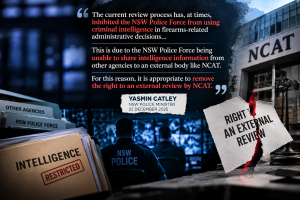
On 22 December 2025, NSW Police Minister Yasmin Catley justified abolishing independent NCAT review of firearms licensing decisions by claiming that the existing process inhibited police from using criminal intelligence.
But the published tribunal record tells a different story. NSW Police had already used criminal intelligence in firearms licensing matters, and NCAT had considered confidential intelligence in reviewing those decisions.
The cases listed below document that practice and raise serious questions about the Minister’s justification. If criminal intelligence was already being used and considered, why was abolishing independent review necessary?
If confidential intelligence could be handled within the tribunal system, what specific barrier required the removal of independent review rights?
Tribunal case library
Browse a selected set of published tribunal decisions classified by the research dataset as involving criminal intelligence in firearms-related matters. Classification is research-derived and does not independently establish what evidence was admitted in each proceeding.
76 verified and approved cases
Chapman v Commissioner of Police, NSW Police Force [2023] NSWCATAD 261
2023-10-13 Outcome not classified NSW Police Force
Closed hearing recorded
View case details
Outcome
What the Tribunal decided and orders made
The Tribunal affirmed the NSW Police Commissioner's decision to refuse the applicant's firearms licence.
The Tribunal considered the applicant's circumstances and confidential police information. It concluded that the Commissioner's decision should be affirmed.
The Tribunal also made procedural orders governing the handling, disclosure and publication of confidential material.
Orders
- The Commissioner's decision was affirmed.
- The hearing concerning confidential material was conducted without the applicant, the applicant's representative or the public.
- The Commissioner was not required to lodge copies of the Confidential Material or Confidential Statement under section 58 of the Administrative Decisions Review Act 1997.
- Publication of the Confidential Material and Confidential Statement was prohibited until further order of the Tribunal.
- Disclosure of the Confidential Material and Confidential Statement was restricted to the Commissioner, the Commissioner's legal representatives and the Tribunal.
- Publication or disclosure of the portions of the Tribunal's reasons marked "NOT FOR PUBLICATION" was prohibited, except to the Commissioner.
Protected information
How confidential or protected intelligence was used
The Tribunal considered confidential police information when reviewing the Commissioner's decision. The information contributed to the Tribunal's reasoning alongside other evidence.
Special procedures were used to protect the confidential material. Part of the hearing was conducted without the applicant, the applicant's legal representative or the public.
The Tribunal also made orders restricting the disclosure and publication of confidential material and specified portions of its reasons.
The confidential material itself is not reproduced in this case summary.
Mechanisms employed
- Closed hearing
- Applicant excluded
- Legal representative excluded
- Public excluded
- Non-publication order
- Non-disclosure / restricted disclosure
- Exemption from lodging confidential copies
- Confidential evidence considered
- Confidential evidence relied upon
Legal framework
Legislation and statutory mechanisms
Firearms Act 1996 (NSW)
Governs firearms licensing in NSW, including the Commissioner's decision to refuse the applicant's licence.
Civil and Administrative Tribunal Act 2013 (NSW)
- Section 49: Used to conduct the confidential portion of the hearing without the applicant, the applicant's representative or the public.
- Section 64(1)(c): Used to prohibit publication or disclosure of specified portions of the Tribunal's reasons.
- Section 64(1)(d): Cited in the order prohibiting publication of the Confidential Material and Confidential Statement.
Administrative Decisions Review Act 1997 (NSW)
- Section 58: Referenced in the order exempting the Commissioner from lodging copies of specified confidential documents.
- Section 59: Referenced in connection with the confidential hearing arrangements.
AI-assisted editorial summary. Refer to the official decision for authoritative reasons and orders.
Costaras v Commissioner of Police [2021] NSWCATAD 333
2021-11-11 Outcome not classified NSW Police Force
Closed hearing recorded
View case details
Outcome
What the Tribunal decided and orders made
Five confidentiality orders granted; substantive licence refusal not determined.
Orders
- Under section 49 of the Civil and Administrative Tribunal Act 2013 (NSW), the substantive hearing, insofar as it concerns the Confidential Material described in the Confidential Statement, is to be conducted without the applicant, the applicant’s legal representatives and the public.
- Under section 59 of the Administrative Decisions Review Act 1997 (NSW), the Commissioner need not lodge copies of the specified Confidential Material identified in the Confidential Statement and confidential exhibits CR3 and CR4.
- Under section 64(1)(c) of the NCAT Act, publication of the Confidential Material, confidential exhibits CR3 and CR4, and their contents is prohibited.
- Under section 64(1)(d) of the NCAT Act, disclosure of that material and its contents is restricted to the Commissioner, the Commissioner’s legal representatives and the Tribunal.
- Under sections 64(1)(b), (c) and (d) of the NCAT Act, publication and recording of the confidential hearing of the preliminary proceedings and its evidence are prohibited; protected paragraphs marked “[NOT FOR PUBLICATION]” must not be published or released to the applicant.
Protected information
How confidential or protected intelligence was used
The Commissioner provided a Confidential Statement and confidential exhibits CR3 and CR4. The Tribunal accepted that disclosure could expose police sources or investigations and granted protective orders. The later substantive hearing was directed to exclude the applicant, the applicant’s legal representatives and the public insofar as it concerned the protected material. Disclosure was limited to the Commissioner, legal representatives for the Commissioner and the Tribunal. The decision was made on the papers, so the order directing a future closed hearing should not be described as proof that the substantive hearing had already occurred.
Mechanisms employed
- Closed hearing
- Applicant excluded
- Legal representative excluded
- Public excluded
- Non-publication order
- Non-disclosure / restricted disclosure
- Exemption from lodging confidential copies
- Confidential evidence received
- Confidential evidence considered
Legal framework
Legislation and statutory mechanisms
Administrative Decisions Review Act 1997 (NSW), s 59 — exemption from lodging confidential documents. Civil and Administrative Tribunal Act 2013 (NSW), s 49 — private hearing and exclusion; s 64(1)(b)–(d) — non-publication and non-disclosure. Firearms Act 1996 (NSW) — underlying licensing review (not decided in this interlocutory ruling).
AI-assisted editorial summary. Refer to the official decision for authoritative reasons and orders.
Dalziell v Commissioner of Police, NSW Police Force [2018] NSWCATAD 79
2018-04-11 Affirmed NSW Police Force
Closed hearing recorded
View case details
Outcome
What the Tribunal decided and orders made
Firearms prohibition order affirmed.
Orders
- The decision under review is affirmed.
Protected information
How confidential or protected intelligence was used
The Commissioner provided confidential police evidence during a closed portion of the hearing. The applicant, legal representatives and public were excluded. Section 64 NCAT restrictions applied to confidentially filed material and paragraphs marked “[Not for publication]”, prohibiting publication or release to the applicant without further order. The Tribunal expressly noted that some protected material was not substantiated but found a significant amount of reliable information supporting the FPO; confidential evidence was therefore received, considered and relied upon. The contents of the protected paragraphs are not reproduced.
Mechanisms employed
- Closed hearing
- Applicant excluded
- Legal representative excluded
- Public excluded
- Non-publication order
- Non-disclosure / restricted disclosure
- Confidential evidence received
- Confidential evidence considered
- Confidential evidence relied upon
Legal framework
Legislation and statutory mechanisms
Firearms Act 1996 (NSW), ss 3, 73, 74 and 74A — public safety, FPOs and associated restrictions/search powers. Crimes Act 1900 (NSW), s 93X — consorting offences and official warnings. Civil and Administrative Tribunal Act 2013 (NSW), ss 49(2), 64 — private hearing and protected material. Administrative Decisions Review Act 1997 (NSW), s 63 — merits review.
AI-assisted editorial summary. Refer to the official decision for authoritative reasons and orders.
El Saadi v Commissioner of Police (No 2) [2021] NSWCATAD 336
2021-11-11 Affirmed NSW Police Force
Closed hearing recorded
View case details
Outcome
What the Tribunal decided and orders made
Licence revocation affirmed; four substantive and confidentiality orders made.
Orders
- Decision under review affirmed.
- Under section 64(1)(c) of the Civil and Administrative Tribunal Act 2013 (NSW), publication of the Confidential Material and confidential exhibits CR3 and CR4, and matters contained in them, is prohibited.
- Under section 64(1)(d) of that Act, disclosure of the Confidential Material and confidential exhibits CR3 and CR4, and matters contained in them, is restricted to the Commissioner, the Commissioner’s legal representatives and the Tribunal.
- Under sections 64(1)(b), (c) and (d) of that Act, publication and recording of the confidential hearing, including exhibits CR3 and CR4 and evidence given there, are prohibited; paragraphs marked “[Not for publication]” must not be published or released to the applicant.
Protected information
How confidential or protected intelligence was used
Confidentiality orders had previously been made in [2021] NSWCATAD 181. The Tribunal considered confidential exhibits CR3 and CR4 alongside the open evidence. The published substantive judgment expressly states that the totality of the evidence, including confidential material, supported the public-interest refusal, establishing substantive reliance. The final orders prohibit publication, restrict disclosure to the Commissioner, the Commissioner’s lawyers and the Tribunal, and protect the confidential hearing and specified paragraphs. Protected material is not reproduced.
Mechanisms employed
- Closed hearing
- Non-publication order
- Non-disclosure / restricted disclosure
- Confidential evidence received
- Confidential evidence considered
- Confidential evidence relied upon
Legal framework
Legislation and statutory mechanisms
Firearms Act 1996 (NSW), s 24(2)(d) — licence revocation. Firearms Regulation 2017 (NSW), cll 17(3) and 20 — firearms storage/address notification and public-interest revocation. Administrative Decisions Review Act 1997 (NSW), ss 53(9) and 63 — internal review and merits review. Civil and Administrative Tribunal Act 2013 (NSW), ss 49 and 64(1)(b)–(d) — confidential hearing and protective orders. Related decision: [2021] NSWCATAD 181.
AI-assisted editorial summary. Refer to the official decision for authoritative reasons and orders.
El-Chamy PSM v Commissioner of Police, NSW Police Force [2023] NSWCATAD 242
2023-09-11 Affirmed NSW Police Force
Closed hearing recorded
View case details
Outcome
What the Tribunal decided and orders made
Affirmed
Orders
- The decision to refuse the Applicant's firearms licence is affirmed.
Protected information
How confidential or protected intelligence was used
The Tribunal made non-disclosure orders concerning confidential material relied upon by the Commissioner. Part of the hearing was conducted in private, excluding the applicant, his legal representative and the public. The Tribunal expressly considered and relied upon confidential material when assessing the applicant's domestic circumstances and the risk to public safety (paragraphs 77 and 84). A non-publication order under section 64(1)(c) of the Civil and Administrative Tribunal Act 2013 (NSW) restricted publication of passages marked "[NOT FOR PUBLICATION]".
Mechanisms employed
- Closed hearing
- Applicant excluded
- Legal representative excluded
- Public excluded
- Non-publication order
- Non-disclosure / restricted disclosure
- Confidential evidence considered
- Confidential evidence relied upon
Legal framework
Legislation and statutory mechanisms
- Administrative Decisions Review Act 1997 (NSW) s 63
- Civil and Administrative Tribunal Act 2013 (NSW) s 38(2)
- Civil and Administrative Tribunal Act 2013 (NSW) s 64(1)(c)
- Firearms Act 1996 (NSW) s 11(3)(a)
- Firearms Act 1996 (NSW) s 11(4)(a)
- Firearms Act 1996 (NSW) s 11(7)
AI-assisted editorial summary. Refer to the official decision for authoritative reasons and orders.
Elrich v Commissioner of Police [2022] NSWCATAD 78
2022-03-09 Affirmed NSW Police Force
Closed hearing recorded
View case details
Outcome
What the Tribunal decided and orders made
Category ABH firearms licence revocation affirmed.
Orders
- The decision under review is affirmed.
Protected information
How confidential or protected intelligence was used
The Commissioner filed material on a confidential basis. The judgment includes a section 64 publication restriction preventing disclosure of that material without further Tribunal order, withholding paragraphs marked Not for publication, and restricting disclosure of records of confidential sessions. The public judgment does not establish that the Tribunal relied on protected intelligence to determine the substantive revocation: its openly stated conclusion focuses on noncompliance with participation and genuine-reason requirements. Do not infer the contents of the protected material or automatically classify confidential evidence as relied upon.
Mechanisms employed
- Closed hearing
- Non-publication order
- Non-disclosure / restricted disclosure
- Confidential evidence received
Legal framework
Legislation and statutory mechanisms
Firearms Act 1996 (NSW), ss 3, 7A(2)(b), 11(7), 12, 19, 24(2)(a), 24(2)(d), 75; Firearms Regulation 2017 (NSW), cls 20, 29, 31, 107, 108, 111; Administrative Decisions Review Act 1997 (NSW), ss 9, 63; Civil and Administrative Tribunal Act 2013 (NSW), s 64.
AI-assisted editorial summary. Refer to the official decision for authoritative reasons and orders.
Farrell v Commissioner of Police [2016] NSWCATAD 96
2016-05-17 Outcome not classified NSW Police Force
No closed-hearing flag in this dataset
View case details
Outcome
What the Tribunal decided and orders made
Firearms licence revocation affirmed.
Orders
- The decision under review is affirmed.
Protected information
How confidential or protected intelligence was used
Confidential information was tendered as exhibit CR1. Paragraphs 62–67 of the published judgment are withheld as not for publication and the publication restriction expressly prevents release to the applicant or public. The Tribunal discussed the protected material in withheld reasons. The accessible judgment does not itself identify a formal exclusion order for the applicant or representative, so those mechanisms are not selected. The precise extent of reliance on CR1 cannot be independently evaluated from the published text.
Mechanisms employed
- Non-publication order
- Non-disclosure / restricted disclosure
- Confidential evidence received
- Confidential evidence considered
Legal framework
Legislation and statutory mechanisms
Firearms Act 1996 (NSW), including licensing revocation and review provisions; Firearms Regulation 2006 (NSW); Administrative Decisions Review Act 1997 (NSW), s 63; Civil and Administrative Tribunal Act 2013 (NSW), s 64.
AI-assisted editorial summary. Refer to the official decision for authoritative reasons and orders.
Fawaz v Commissioner of Police, New South Wales Police Force [2022] NSWCATAD 317
2022-09-28 Affirmed Commissioner of Police, New South Wales Police Force
Closed hearing recorded
View case details
Outcome
What the Tribunal decided and orders made
Firearms prohibition order affirmed.
The Tribunal upheld the Commissioner's decision to impose a firearms prohibition order under section 73(1) of the Firearms Act 1996 (NSW).
The Tribunal found that the applicant had knowingly permitted unlicensed individuals to use firearms, had threatened another person with a pistol, and had associations connecting the applicant to organised crime.
The Tribunal concluded that the applicant was not fit, in the public interest, to possess firearms.
The Tribunal also made orders restricting publication and disclosure of confidential evidence, confidential exhibit CR6, the confidential hearing and protected portions of the reasons for decision.
Orders
- Decision under review affirmed.
- Pursuant to section 64(1)(c) of the Civil and Administrative Tribunal Act 2013 (NSW), publication of the Confidential Material and confidential exhibit CR6, or matters contained in them, is prohibited.
- Pursuant to section 64(1)(d) of the Civil and Administrative Tribunal Act 2013 (NSW), disclosure of the Confidential Material and confidential exhibit CR6, or matters contained in them, is restricted to the Commissioner, the Commissioner's legal representatives and the Tribunal.
- Pursuant to sections 64(1)(b), 64(1)(c) and 64(1)(d) of the Civil and Administrative Tribunal Act 2013 (NSW), publication and recording of the confidential hearing, including confidential exhibit CR6 and evidence given during that hearing, is prohibited. The contents of paragraphs marked "[Not for publication]" must not be published or released to the applicant.
Protected information
How confidential or protected intelligence was used
The Commissioner relied on confidential police information in support of the firearms prohibition order.
Earlier confidentiality orders were made on 4 March 2022 under section 59 of the Administrative Decisions Review Act 1997 (NSW) and section 64 of the Civil and Administrative Tribunal Act 2013 (NSW).
A confidential hearing was conducted on 12 September 2022 pursuant to section 49(2) of the Civil and Administrative Tribunal Act 2013 (NSW).
The applicant challenged the Commissioner's reliance on confidential information, arguing that the restrictions prevented meaningful examination of the allegations and impaired procedural fairness.
The Tribunal considered the confidential evidence alongside open evidence when determining whether the applicant was fit, in the public interest, to possess firearms.
The final decision prohibited publication of the Confidential Material and confidential exhibit CR6 and restricted their disclosure to the Commissioner, the Commissioner's legal representatives and the Tribunal.
The Tribunal also prohibited publication and recording of the confidential hearing and prohibited publication or release to the applicant of paragraphs marked "[Not for publication]".
The publicly available judgment does not reveal the contents of the protected paragraphs or confidential exhibit CR6. Their contents must not be inferred or reconstructed.
The Tribunal affirmed the firearms prohibition order after considering the available evidence. The public reasons also identify significant adverse findings based on evidence discussed openly in the judgment.
Mechanisms employed
- Closed hearing
- Exemption from lodging confidential copies
- Confidential evidence relied upon
Legal framework
Legislation and statutory mechanisms
Firearms Act 1996 (NSW)
Section 73(1) — Authorises the Commissioner to impose a firearms prohibition order where the person is considered not fit, in the public interest, to possess firearms.
Section 74 — Establishes prohibitions on acquiring, possessing or using firearms, firearm parts and ammunition while subject to an FPO.
Section 74A — Provides special police search powers relating to persons subject to firearms prohibition orders.
Administrative Decisions Review Act 1997 (NSW)
Section 55 — Relevant to the Tribunal's administrative review jurisdiction and procedures.
Section 59 — Provides for exemptions from ordinary document-lodgement requirements, relevant to the earlier confidentiality orders.
Section 63 — Governs the Tribunal's determination of the correct and preferable decision on administrative review.
Civil and Administrative Tribunal Act 2013 (NSW)
Section 49(2) — Provides for a hearing, or part of a hearing, to be conducted in private.
Section 64(1)(b) — Provides for restrictions on publication or reporting of proceedings.
Section 64(1)(c) — Provides for restrictions on publication of evidence, documents or information.
Section 64(1)(d) — Provides for restrictions on disclosure of evidence, documents or information.
Relevant authorities considered included Grant v Commissioner of Police [2020] NSWCATAD 158, Wilson v Commissioner of Police [2018] NSWCATAD 274, and Briginshaw v Briginshaw (1938) 60 CLR 336.
AI-assisted editorial summary. Refer to the official decision for authoritative reasons and orders.
Ferkh v Commissioner of Police, NSW Police Force [2023] NSWCATAD 231
2023-08-25 Set Aside NSW Police Force
No closed-hearing flag in this dataset
View case details
Outcome
What the Tribunal decided and orders made
Set aside
Orders
- The decision under review is set aside.
Protected information
How confidential or protected intelligence was used
The Commissioner filed confidential material under section 59 of the Administrative Decisions Review Act 1997 (NSW), but did not seek to rely on it. At paragraph 9, the Tribunal expressly stated that the confidential material was not taken into account in reaching its decision. The Tribunal determined the review on the evidence it considered relevant without relying on the filed confidential material.
Mechanisms employed
- Confidential material filed but not relied upon
Legal framework
Legislation and statutory mechanisms
- Civil and Administrative Tribunal Act 2013
- Administrative Decisions Review Act 1997
- Firearms Act 1996
- Weapons Prohibition Act 1998
AI-assisted editorial summary. Refer to the official decision for authoritative reasons and orders.
GGW v Commissioner of Police, New South Wales Police Force [2023] NSWCATAD 155
2023-06-19 Outcome not classified Commissioner of Police, New South Wales Police Force
Closed hearing recorded
View case details
Outcome
What the Tribunal decided and orders made
Decision under review affirmed
Orders
- (1) Decision under review is affirmed.
- (2) Pursuant to s 64(1)(c) of the Civil and Administrative Tribunal Act (CAT Act), the publication of the Confidential Material and confidential exhibit CR3, or matters contained in the Confidential Material and confidential exhibit CR3 is prohibited.
- (3) Pursuant to s 64(1)(d) of the CAT Act, the disclosure of the Confidential Material and confidential exhibit CR3, or matters contained in the Confidential Material and confidential exhibit CR3, is restricted to the Commissioner, the legal representatives for the Commissioner and the tribunal.
- (4) Pursuant to ss 64(1)(b), 64(1)(c) and 64(1)(d) of the CAT Act, the publication and recording of the confidential hearing of these proceedings, including confidential exhibit CR3 and any evidence given during the hearing, is prohibited, and the contents of all paragraphs in these reasons marked â[Not for publication]â are not to be published or released to the applicant.
Protected information
How confidential or protected intelligence was used
The case involved confidential police information about OMCG associations, which was subject to non-publication and non-disclosure orders under s64 CAT Act. The applicant was excluded from this material, limiting procedural fairness.
Mechanisms employed
- Closed hearing
- Applicant excluded
- Non-publication order
- Non-disclosure / restricted disclosure
- Confidential evidence considered
Legal framework
Legislation and statutory mechanisms
- Administrative Decisions Review Act 1997 (NSW)
- Civil and Administrative Tribunal Act 2013 (NSW)
- Firearms Act 1996 (NSW)
AI-assisted editorial summary. Refer to the official decision for authoritative reasons and orders.
Goulton v Commissioner of Police [2022] NSWCATAD 68
2022-03-01 Outcome not classified NSW Police Force
Closed hearing recorded
View case details
Outcome
What the Tribunal decided and orders made
Confidentiality application granted; substantive firearms prohibition order review not determined.
Orders
- Under section 49 of the Civil and Administrative Tribunal Act 2013 (NSW), the confidentiality application and the substantive hearing, insofar as they concern the specified Confidential Documents, are to proceed without the applicant, the applicant’s legal representatives and the public.
- Under section 59 of the Administrative Decisions Review Act 1997 (NSW), the Commissioner is not required to lodge copies of the specified Confidential Documents.
- Under section 64(1)(c) of the Civil and Administrative Tribunal Act 2013 (NSW), publication of the Confidential Documents, Confidential Affidavit and their contents is prohibited.
- Under section 64(1)(d) of that Act, disclosure of the Confidential Documents, Confidential Affidavit and their contents to the applicant or the applicant’s legal representatives is prohibited.
- Under sections 64(1)(b), (c) and (d) of that Act, the transcript and recording of the confidential hearing in the preliminary proceedings must not be published or released to the applicant, the applicant’s legal representatives or the public.
Protected information
How confidential or protected intelligence was used
The Tribunal examined a confidential affidavit and associated documents during a preliminary confidentiality application. The Commissioner argued that disclosure could reveal intelligence sources, policing methods and investigative activity. The Tribunal granted a section 49 private-hearing order excluding the applicant, legal representatives and public from the specified confidential portions; a section 59 exemption from lodging confidential copies; and section 64 publication and disclosure restrictions. The protected information was received and considered to decide confidentiality, not adjudicated for its truth or weight on the underlying FPO merits. Protected passages and document contents are not reproduced.
Mechanisms employed
- Closed hearing
- Applicant excluded
- Legal representative excluded
- Public excluded
- Non-publication order
- Non-disclosure / restricted disclosure
- Exemption from lodging confidential copies
- Confidential evidence received
- Confidential evidence considered
Legal framework
Legislation and statutory mechanisms
Firearms Act 1996 (NSW), s 73 (underlying FPO review); Administrative Decisions Review Act 1997 (NSW), ss 58–59; Civil and Administrative Tribunal Act 2013 (NSW), ss 38(2), 49, 64(1)(b)–(d).
AI-assisted editorial summary. Refer to the official decision for authoritative reasons and orders.
Grant v Commissioner of Police [2020] NSWCATAD 158
2020-06-23 Outcome not classified NSW Police Force
Closed hearing recorded
View case details
Outcome
What the Tribunal decided and orders made
Licence revocation set aside.
Orders
- The Commissioner’s decision to revoke the applicant’s firearms licence is set aside.
Protected information
How confidential or protected intelligence was used
The Commissioner filed confidential evidence and submissions concerning informants and current criminal investigations. The Tribunal held part of the hearing privately under section 49(2) and made section 64(1)(c) and (d) orders restricting publication and disclosure to the applicant. It explained that section 75(5) of the Firearms Act was not the basis of the Commissioner’s confidentiality application. The Tribunal considered protected evidence, but gave little or no weight to unidentified-source allegations, speculative comments and adverse matters that could have been put to the applicant but were not. Protected paragraphs remain omitted from public reasons. The confidential evidence did not justify the revocation.
Mechanisms employed
- Closed hearing
- Public excluded
- Non-publication order
- Non-disclosure / restricted disclosure
- Confidential evidence received
- Confidential evidence considered
Legal framework
Legislation and statutory mechanisms
Firearms Act 1996 (NSW), ss 3, 11(5)(d)(i), 24(2)(a), (c), (d), 75(5) — public safety, prescribed offence restrictions, revocation grounds and special intelligence protections (the latter discussed but not invoked for the confidentiality application). Firearms Regulation 2017 (NSW), cl 5(2)(b) and cl 20 — prescribed offences and public-interest revocation. Crimes (Sentencing Procedure) Act 1999 (NSW), s 104 and Sch 2 cl 77 — conditional release order references. Administrative Decisions Review Act 1997 (NSW), s 63 — merits review. Civil and Administrative Tribunal Act 2013 (NSW), ss 38(2), 49(2), 64(1)(c)–(d) — natural justice, private hearing and confidentiality.
AI-assisted editorial summary. Refer to the official decision for authoritative reasons and orders.
Hassall v Commissioner of Police [2021] NSWCATAD 101
2021-04-27 Outcome not classified NSW Police Force
Closed hearing recorded
View case details
Outcome
What the Tribunal decided and orders made
Five procedural confidentiality orders granted; licence revocation merits not determined.
Orders
- Under section 49 of the Civil and Administrative Tribunal Act 2013 (NSW), the substantive hearing insofar as it concerns Confidential Material is to proceed without the applicant, the applicant’s legal representatives and the public.
- Under section 59 of the Administrative Decisions Review Act 1997 (NSW), the Commissioner need not lodge specified confidential documents or parts described in the Confidential Statement and exhibit CR3.
- Under section 64(1)(c) of the NCAT Act, publication of Confidential Material, exhibit CR3 and their contents is prohibited.
- Under section 64(1)(d), disclosure of Confidential Material, exhibit CR3 and their contents is restricted to the Commissioner, the Commissioner’s legal representatives and the Tribunal.
- Under sections 64(1)(b)–(d), publication and recording of the confidential preliminary hearing and evidence are prohibited; paragraphs marked not for publication must not be released to the applicant.
Protected information
How confidential or protected intelligence was used
The Commissioner sought ex parte protection of a confidential statement and exhibit CR3. The Tribunal assumed the confidential evidence for purposes of deciding protection, found a cogent case for confidentiality, and issued section 49 private-hearing/exclusion, section 59 lodging exemption and section 64 non-publication and non-disclosure orders. The decision contains protected paragraphs. These findings do not resolve whether the underlying allegations justify revocation; that issue was addressed separately in [2022] NSWCATAD 47.
Mechanisms employed
- Closed hearing
- Applicant excluded
- Legal representative excluded
- Public excluded
- Non-publication order
- Non-disclosure / restricted disclosure
- Exemption from lodging confidential copies
- Confidential evidence received
- Confidential evidence considered
Legal framework
Legislation and statutory mechanisms
Firearms Act 1996 (NSW) — underlying licence revocation. Administrative Decisions Review Act 1997 (NSW), ss 53(9)(b), 58–59 — deemed internal review and document-lodgement exemption. Civil and Administrative Tribunal Act 2013 (NSW), ss 49, 64(1)(b)–(d) — private hearing and non-publication/non-disclosure.
AI-assisted editorial summary. Refer to the official decision for authoritative reasons and orders.
Hermann v Commissioner of Police [2020] NSWCATAD 127
2020-05-20 Set Aside NSW Police Force
No closed-hearing flag in this dataset
View case details
Outcome
What the Tribunal decided and orders made
Licence revocation set aside; Category H firearms licence reinstated; costs reserved.
Orders
- The decision under review is set aside and the applicant’s firearms licence is reinstated.
- Costs reserved.
Protected information
How confidential or protected intelligence was used
The Tribunal ordered under section 64 of the Civil and Administrative Tribunal Act 2013 (NSW) that specified identifying and security-sensitive information not be disclosed. The protected categories included the identity of an individual involved in the incident, photographs of the school and surroundings, and information about the security provider’s risk assessment and response protocols. This was a targeted suppression or disclosure restriction, not an established police-intelligence closed-hearing process. The decision does not establish confidential police evidence received or relied upon.
Mechanisms employed
- Non-disclosure / restricted disclosure
Legal framework
Legislation and statutory mechanisms
Firearms Act 1996 (NSW), ss 3, 11, 24 — public-safety principles, licensing restrictions and revocation. Civil and Administrative Tribunal Act 2013 (NSW), ss 60, 64 — costs and restrictions on disclosure. The Tribunal considered public interest, the applicant’s conduct and whether continuation of the firearms licence posed a safety risk.
AI-assisted editorial summary. Refer to the official decision for authoritative reasons and orders.
Howison v Commissioner of Police [2021] NSWCATAD 157
2021-06-07 Outcome not classified NSW Police Force
Closed hearing recorded
View case details
Outcome
What the Tribunal decided and orders made
Category AB firearms licence refusal affirmed; confidentiality orders also made.
Orders
- Decision under review affirmed.
- Under section 49 of the Civil and Administrative Tribunal Act 2013 (NSW), the hearing insofar as it relates to confidential exhibit CR3 is to proceed without the applicant, the applicant’s legal representatives and the public.
- Under section 64(1)(c), publication of the Confidential Material, confidential exhibit CR3 and specified matters contained in the confidential exhibits is prohibited.
- Under section 64(1)(d), disclosure of the Confidential Material and confidential exhibit CR3 is restricted to the Commissioner, the Commissioner’s legal representatives and the Tribunal.
- Under sections 64(1)(b)–(d), publication and recording of the confidential hearing and its evidence is prohibited, and paragraphs marked not for publication must not be published or released to the applicant.
Protected information
How confidential or protected intelligence was used
The Commissioner tendered confidential exhibit CR3 late in the substantive hearing. The applicant objected that additional undisclosed evidence was unfair and could not be answered. The Tribunal granted a confidential hearing and restrictions under sections 49 and 64 of the NCAT Act, reasoning that disclosure could compromise criminal investigations, identify police sources and endanger individuals. The applicant, representatives and public were excluded from the protected hearing. The Tribunal expressly included confidential evidence in its final public-interest assessment. The published order 3 inconsistently refers to CR2 while identifying CR3; this summary preserves that discrepancy rather than claiming the exhibits are identical.
Mechanisms employed
- Closed hearing
- Applicant excluded
- Legal representative excluded
- Public excluded
- Non-publication order
- Non-disclosure / restricted disclosure
- Confidential evidence received
- Confidential evidence considered
- Confidential evidence relied upon
Legal framework
Legislation and statutory mechanisms
Firearms Act 1996 (NSW), ss 3, 11(7) — public safety and public-interest refusal. Administrative Decisions Review Act 1997 (NSW), s 63 — merits review. Civil and Administrative Tribunal Act 2013 (NSW), ss 49, 64(1)(b)–(d) — private hearing and publication/disclosure restrictions. Firearms Regulation 2017 (NSW) — licensing context.
AI-assisted editorial summary. Refer to the official decision for authoritative reasons and orders.
Research and legal notice: This is a selected, non-exhaustive research dataset, not a representative sample of all tribunal matters. AI-assisted classification may contain errors. Nothing here constitutes legal advice. Case titles are reproduced unchanged as public legal citations; this is not full anonymisation. Source decisions should be checked before drawing conclusions.