CRIMINAL INTELLIGENCE. NCAT. THE DOCUMENTED RECORD
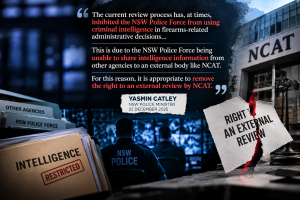
On 22 December 2025, NSW Police Minister Yasmin Catley justified abolishing independent NCAT review of firearms licensing decisions by claiming that the existing process inhibited police from using criminal intelligence.
But the published tribunal record tells a different story. NSW Police had already used criminal intelligence in firearms licensing matters, and NCAT had considered confidential intelligence in reviewing those decisions.
The cases listed below document that practice and raise serious questions about the Minister’s justification. If criminal intelligence was already being used and considered, why was abolishing independent review necessary?
If confidential intelligence could be handled within the tribunal system, what specific barrier required the removal of independent review rights?
Tribunal case library
Browse a selected set of published tribunal decisions classified by the research dataset as involving criminal intelligence in firearms-related matters. Classification is research-derived and does not independently establish what evidence was admitted in each proceeding.
76 verified and approved cases
Hughes v Commissioner of Police [2022] NSWCATAD 219
2022-07-01 Outcome not classified NSW Police Force
Closed hearing recorded
View case details
Outcome
What the Tribunal decided and orders made
Revocation affirmed; confidentiality orders of 3 June 2021 continued.
Orders
- The Respondent’s decision to revoke the Applicant’s Category AB firearms licence is affirmed.
- The confidentiality orders made 3 June 2021 are continued.
Protected information
How confidential or protected intelligence was used
The Commissioner presented confidential reports and confidential exhibit CR3. On 3 June 2021 the Tribunal exempted the Commissioner from lodging specified confidential copies under section 59 of the Administrative Decisions Review Act 1997 (NSW), prohibited publication under section 64(1)(c) of the Civil and Administrative Tribunal Act 2013 (NSW), restricted disclosure under section 64(1)(d), and prohibited publication and recording of the confidential preliminary hearing under sections 64(1)(b)–(d). The substantive reasons contain protected paragraphs. The Tribunal expressly stated that the result would be unchanged without confidential information; do not code substantive reliance on confidential evidence.
Mechanisms employed
- Closed hearing
- Non-publication order
- Non-disclosure / restricted disclosure
- Exemption from lodging confidential copies
- Confidential evidence received
- Confidential evidence considered
Legal framework
Legislation and statutory mechanisms
Firearms Act 1996 (NSW): firearms licensing, genuine reason and public safety; Firearms Regulation 2017 (NSW): safe storage and regulatory requirements; Administrative Decisions Review Act 1997 (NSW), s 59: exemption from lodging confidential documents; Civil and Administrative Tribunal Act 2013 (NSW), ss 49 and 64: private hearings and restrictions on publication/disclosure.
AI-assisted editorial summary. Refer to the official decision for authoritative reasons and orders.
Ibrahim v Commissioner of Police, NSW Police Force [2019] NSWCATAD 41
2019-03-21 Outcome not classified NSW Police Force
Closed hearing recorded
View case details
Outcome
What the Tribunal decided and orders made
Commissioner exempted from lodging specified confidential documents; substantive FPO review not determined.
Orders
- The Commissioner of Police, NSW Police Force is not required to lodge copies of the documents specified in the confidential affidavit filed in support of this application.
Protected information
How confidential or protected intelligence was used
The Commissioner sought protection for documents identified in a confidential affidavit. The Tribunal heard the application privately, excluding the applicant, legal representatives and public. It referred to sections 49 and 64 of the Civil and Administrative Tribunal Act 2013 (NSW) and the disclosure prohibition contemplated by section 59(2) of the Administrative Decisions Review Act 1997 (NSW). The judgment records a publication and reporting restriction on the confidentiality hearing, and the substantive reasons include paragraphs marked not for publication. The operative order granted a section 59 exemption; it did not decide the firearms prohibition order or assign substantive evidentiary weight to the protected documents.
Mechanisms employed
- Closed hearing
- Applicant excluded
- Legal representative excluded
- Public excluded
- Non-publication order
- Non-disclosure / restricted disclosure
- Exemption from lodging confidential copies
- Confidential evidence received
- Confidential evidence considered
Legal framework
Legislation and statutory mechanisms
Firearms Act 1996 (NSW), s 73 — underlying firearms prohibition order. Administrative Decisions Review Act 1997 (NSW), ss 58(1)(b), 59(1)–(2) — ordinary lodgement of relevant documents and exemption where non-disclosure is appropriate. Civil and Administrative Tribunal Act 2013 (NSW), ss 49(2), 64(1)(b)–(d) — private hearings and restrictions on reporting, publication and disclosure.
AI-assisted editorial summary. Refer to the official decision for authoritative reasons and orders.
Johns v Commissioner of Police, New South Wales Police Force [2021] NSWCATAD 283
2021-09-28 Outcome not classified Commissioner of Police, New South Wales Police Force
Closed hearing recorded
View case details
Outcome
What the Tribunal decided and orders made
Mixed outcome: first applicant’s licence revocation affirmed; second applicant’s revocation set aside. Confidentiality orders also made.
Orders
- The decision under review relating to the first applicant is affirmed.
- The decision under review relating to the second applicant is set aside.
- Under section 64(1)(c) of the Civil and Administrative Tribunal Act 2013 (NSW), publication of the Confidential Material and confidential exhibit CR4, and matters contained in them, is prohibited.
- Under section 64(1)(d) of that Act, disclosure of the Confidential Material and confidential exhibit CR4, and matters contained in them, is restricted to the Commissioner, the Commissioner’s legal representatives and the Tribunal.
- Under sections 64(1)(b), (c) and (d) of that Act, publication and recording of the confidential hearing, including exhibit CR4 and evidence given during it, are prohibited; paragraphs marked “[Not for publication]” must not be published or released to the applicant.
Protected information
How confidential or protected intelligence was used
The Commissioner relied on confidential police material in the review proceedings. Confidential exhibit CR4 and protected paragraphs were subject to section 64 orders. The Tribunal prohibited publication, restricted disclosure to the Commissioner, the Commissioner’s lawyers and the Tribunal, and prohibited publication and recording of the confidential hearing. The public reasons distinguish the two applicants’ circumstances: the first revocation was affirmed on the prescribed-offence and conditional-release-order grounds, whereas the second was set aside because the adverse material did not justify revocation. The confidential evidence was received and considered; the public decision should not be summarised as showing that it was decisive in either outcome. The contents of protected material are not reproduced.
Mechanisms employed
- Closed hearing
- Non-publication order
- Non-disclosure / restricted disclosure
- Confidential evidence received
- Confidential evidence considered
Legal framework
Legislation and statutory mechanisms
Firearms Act 1996 (NSW), ss 3, 11(5)(d), 24 — licensing, prescribed-offence disqualification and revocation. Firearms Regulation 2017 (NSW), cl 5(2)(a) — prescribed weapons offences. Weapons Prohibition Act 1998 (NSW), Sch 1 — silencers as prohibited weapons. Administrative Decisions Review Act 1997 (NSW), s 63 — merits review. Civil and Administrative Tribunal Act 2013 (NSW), ss 49 and 64(1)(b)–(d) — confidential hearing and protective orders.
AI-assisted editorial summary. Refer to the official decision for authoritative reasons and orders.
Johnson v Commissioner of Police, NSW Police Force [2017] NSWCATAD 291
2017-09-28 Outcome not classified Commissioner for Police, NSW Police Force
Closed hearing recorded
View case details
Outcome
What the Tribunal decided and orders made
Original access decision set aside and substituted; limited additional information ordered released.
Orders
- The respondent’s decision of 21 October 2016 is set aside.
- In substitution, the DNA Link Notification is released in part with the previously redacted name and CNI withheld.
- The facsimile, police report and forensic examination request are released in part, retaining redactions of two mobile numbers.
- The controlled-operation authority CO10/275 and application CO/10/275 are released in part, retaining previous redactions except for specified words in inverted commas at Annexure A, which are to be released.
Protected information
How confidential or protected intelligence was used
The Tribunal received confidential material and held a closed hearing to evaluate police claims for withholding information. The published record indicates protection of informant and operational information and a restriction on publishing parts of the reasons. The applicant did not receive the confidential information. The record does not establish that the applicant’s legal representative was formally excluded, so that checkbox is not selected. The Tribunal directly considered withheld documents in deciding the disclosure dispute.
Mechanisms employed
- Closed hearing
- Applicant excluded
- Public excluded
- Non-publication order
- Non-disclosure / restricted disclosure
- Confidential evidence received
- Confidential evidence considered
- Confidential evidence relied upon
Legal framework
Legislation and statutory mechanisms
Government Information (Public Access) Act 2009 (NSW) — access to government information and public-interest considerations; Administrative Decisions Review Act 1997 (NSW), s 63 — merits review; Civil and Administrative Tribunal Act 2013 (NSW) — hearing confidentiality and publication protections.
AI-assisted editorial summary. Refer to the official decision for authoritative reasons and orders.
Kassem v Commissioner of Police [2021] NSWCATAD 213
2021-07-23 Affirmed NSW Police Force
Closed hearing recorded
View case details
Outcome
What the Tribunal decided and orders made
Category AB firearms licence revocation affirmed.
Orders
- The decision under review is affirmed.
Protected information
How confidential or protected intelligence was used
Confidential information reports were before the Tribunal under earlier section 59 document-lodgement orders. Non-publication and non-disclosure restrictions under section 64 of the Civil and Administrative Tribunal Act 2013 (NSW) protected confidential evidence and submissions, including evidence presented in a private session. The applicant could not access the specified protected material. In the substantive decision, the Tribunal expressly referred to the confidential information as contributing to its public-interest assessment, but only to a lesser extent than the repeated participation breaches. No inference is drawn about the withheld contents.
Mechanisms employed
- Closed hearing
- Non-publication order
- Non-disclosure / restricted disclosure
- Exemption from lodging confidential copies
- Confidential evidence received
- Confidential evidence considered
- Confidential evidence relied upon
Legal framework
Legislation and statutory mechanisms
Firearms Act 1996 (NSW), ss 3, 24(2)(b)(ii)–(iii), 24(2)(d) — public safety and licence revocation for regulatory and condition breaches or prescribed grounds. Firearms Regulation 2006 (NSW), cls 20, 31, 108 — public interest and participation requirements as cited in the judgment. Administrative Decisions Review Act 1997 (NSW), ss 53(9)(b), 58–59, 63 — internal review, confidential document handling and merits review. Civil and Administrative Tribunal Act 2013 (NSW), ss 28(2), 38(2), 49, 64 — evidence, natural justice and confidentiality protections.
AI-assisted editorial summary. Refer to the official decision for authoritative reasons and orders.
Katelaris v Commissioner of Police [2022] NSWCATAD 171
2022-05-25 Outcome not classified NSW Police Force
Closed hearing recorded
View case details
Outcome
What the Tribunal decided and orders made
Interlocutory confidentiality application granted; firearms licence merits not determined.
Orders
- Under section 49(2) of the Civil and Administrative Tribunal Act 2013 (NSW), the substantive hearing, insofar as it concerns Confidential Material, is to be held without the applicant, any legal representative for the applicant or the public.
- Under section 59 of the Administrative Decisions Review Act 1997 (NSW), the Commissioner is exempt from lodging copies of the Confidential Material under section 58.
- Under section 64(1)(c) of the Civil and Administrative Tribunal Act 2013 (NSW), publication of the Confidential Material is prohibited.
- Under section 64(1)(d), disclosure of the Confidential Material is restricted to the Commissioner, the Commissioner’s legal representatives and the Tribunal.
- Under sections 64(1)(b) and 64(1)(c), publication and reporting of the private hearing and evidence given there is prohibited.
Protected information
How confidential or protected intelligence was used
The Tribunal received and examined confidential police material and heard confidential submissions. It found that the information exposed police methodology, current criminal investigations and confidential sources. The applicant objected to secrecy and raised concerns about covert surveillance. The Tribunal accepted the need for protective orders despite the procedural unfairness that can arise when an applicant cannot see or answer material. It made closed-hearing, attendance-exclusion, non-publication, non-disclosure and document-lodgement-exemption orders. It made no findings about the credibility or substantive merits weight of the confidential material.
Mechanisms employed
- Closed hearing
- Applicant excluded
- Legal representative excluded
- Public excluded
- Non-publication order
- Non-disclosure / restricted disclosure
- Exemption from lodging confidential copies
- Confidential evidence received
- Confidential evidence considered
Legal framework
Legislation and statutory mechanisms
Firearms Act 1996 (NSW), ss 11(4)(a), 11(7); Administrative Decisions Review Act 1997 (NSW), ss 48, 58, 59; Civil and Administrative Tribunal Act 2013 (NSW), ss 49(1)–(2), 64(1)(b)–(d). Authorities discussed include Brennan v State of New South Wales [2006] NSWSC 167, Grant v Commissioner of Police [2020] NSWCATAD 158 and Constantin v Commissioner of Police [2013] NSWADTAP 16.
AI-assisted editorial summary. Refer to the official decision for authoritative reasons and orders.
Kocic v Commissioner of Police, NSW Police Force [2023] NSWCATAD 32
2023-02-08 Outcome not classified NSW Police Force
Closed hearing recorded
View case details
Outcome
What the Tribunal decided and orders made
Respondent’s decision affirmed.
Orders
- The respondent’s decision is affirmed.
Protected information
How confidential or protected intelligence was used
The Tribunal conducted a closed hearing and relied on confidential material to decide that the applicant was not fit and proper and it was contrary to public interest to grant a firearms licence.
Mechanisms employed
- Closed hearing
- Confidential evidence considered
- Confidential evidence relied upon
Legal framework
Legislation and statutory mechanisms
- Administrative Decisions Review Act 1997
- Civil and Administrative Tribunal Act 2013
- Firearms Act 1996
AI-assisted editorial summary. Refer to the official decision for authoritative reasons and orders.
Kopko v Commissioner of Police, New South Wales Police Force [2018] NSWCATAD 124
2018-06-07 Affirmed Commissioner of Police, New South Wales Police Force
Closed hearing recorded
View case details
Outcome
What the Tribunal decided and orders made
Category AB firearms licence renewal refusal affirmed; non-publication and non-disclosure restrictions imposed.
Orders
- The decision under review is affirmed.
- Pursuant to sections 64(1)(c) and (d) of the Civil and Administrative Tribunal Act 2013 (NSW), the transcript and recording of the confidential hearing, confidential exhibit CR3 and the contents of all paragraphs marked “[Not for publication]” are not to be published or released to the applicant.
Protected information
How confidential or protected intelligence was used
The Commissioner relied on confidential exhibit CR3 and a private hearing conducted under section 49(2) of the Civil and Administrative Tribunal Act 2013 (NSW). Protected portions of the reasons were not published. The Tribunal expressly acknowledged that the applicant could not test the confidential evidence, but stated that its importance and weight were considerable. This confidential evidence materially changed the assessment: the open evidence alone supported a respectable case for renewal, whereas the combined evidence established a slight but significant public-safety risk. The Tribunal imposed section 64(1)(c) and (d) publication and disclosure restrictions. The public judgment does not expressly establish a section 59 document-lodgement exemption or the precise physical exclusion of legal representatives.
Mechanisms employed
- Closed hearing
- Public excluded
- Non-publication order
- Non-disclosure / restricted disclosure
- Confidential evidence received
- Confidential evidence considered
- Confidential evidence relied upon
Legal framework
Legislation and statutory mechanisms
Firearms Act 1996 (NSW), ss 3 and 11 — public-safety and licensing/public-interest considerations. Firearms Regulation 2017 (NSW) — relevant firearms licensing framework. Administrative Decisions Review Act 1997 (NSW), s 63 — merits review. Civil and Administrative Tribunal Act 2013 (NSW), ss 49(2), 64(1)(c)–(d) — private hearing, non-publication and restricted disclosure.
AI-assisted editorial summary. Refer to the official decision for authoritative reasons and orders.
Laughton v Commissioner of Police [2022] NSWCATAD 240
2022-07-18 Outcome not classified NSW Police Force
Closed hearing recorded
View case details
Outcome
What the Tribunal decided and orders made
Confidentiality application granted; five procedural orders made.
The Tribunal authorised a private hearing excluding the applicant, the applicant's legal representative and the public from the confidential portion of the proceedings.
It exempted the Commissioner from lodging specified confidential documents and imposed restrictions on publication, reporting and disclosure of the confidential documents, confidential statement and evidence given during the private hearing.
The Tribunal did not determine the merits of the firearms licence revocation and expressly reserved assessment of the confidential material's credibility for the substantive hearing.
Orders
- Pursuant to section 49(2) of the Civil and Administrative Tribunal Act 2013 (NSW), the hearing of this application is to be conducted in the absence of the applicant, the applicant's legal representative and the public (the Private Hearing).
- Pursuant to section 59 of the Administrative Decisions Review Act 1997 (NSW), the Commissioner is not required to lodge copies of the documents, omitting pages 17 to 23 (the Confidential Documents), described in the confidential statement provided to the Tribunal by the Commissioner (the Confidential Statement).
- Pursuant to section 64(1)(c) of the Civil and Administrative Tribunal Act 2013 (NSW), publication of any evidence given during the Private Hearing, the Confidential Documents, the Confidential Statement and matters contained in those documents or statement is prohibited.
- Pursuant to section 64(1)(d) of the Civil and Administrative Tribunal Act 2013 (NSW), disclosure of any evidence given during the Private Hearing, the Confidential Documents, the Confidential Statement and matters contained in those documents or statement is restricted to the Commissioner, the Commissioner's legal representative and the Tribunal.
- Pursuant to sections 64(1)(b) and 64(1)(c) of the Civil and Administrative Tribunal Act 2013 (NSW), publication and reporting of the Private Hearing, including any evidence given during it, is prohibited.
Protected information
How confidential or protected intelligence was used
The Commissioner sought confidentiality protections for specified police documents and a confidential statement containing criminal intelligence, criminal reports, criminal history information, police methodology, information about current investigations and confidential sources.
The Tribunal received the confidential material and examined it during the interlocutory proceedings. It accepted police evidence that the material contained sensitive information ordinarily accessible only to authorised law enforcement personnel.
The applicant opposed the application, arguing that the inability to examine confidential evidence or cross-examine witnesses would prejudice procedural fairness.
The Tribunal acknowledged the unfairness associated with withholding evidence but concluded that the statutory confidentiality mechanisms could be used where justified by the public interest.
The Tribunal considered that the applicant had received sufficient information about the substance of the allegations to present a case.
Orders were made under section 49(2) of the Civil and Administrative Tribunal Act 2013 (NSW) excluding the applicant, the applicant's legal representative and the public from the private hearing.
Under section 59 of the Administrative Decisions Review Act 1997 (NSW), the Commissioner was exempted from lodging specified confidential documents.
Under section 64 of the Civil and Administrative Tribunal Act 2013 (NSW), publication and reporting of the private hearing and protected material were prohibited, and disclosure was restricted to the Commissioner, the Commissioner's legal representative and the Tribunal.
The Tribunal expressly stated that it made no findings about the credibility of the confidential material. That question was reserved for the substantive hearing.
The decision therefore authorised confidentiality protections but did not determine whether the protected intelligence established grounds for revoking the applicant's firearms licence.
Mechanisms employed
- Closed hearing
- Applicant excluded
- Legal representative excluded
- Public excluded
- Non-publication order
- Non-disclosure / restricted disclosure
- Exemption from lodging confidential copies
- Confidential evidence received
- Confidential evidence considered
Legal framework
Legislation and statutory mechanisms
Firearms Act 1996 (NSW)
Section 24(2)(d) — Public-interest ground relevant to revocation of a firearms licence. The substantive review concerned whether the applicant should continue to hold a firearms licence.
Administrative Decisions Review Act 1997 (NSW)
Section 48 — Relevant to the conduct of administrative review proceedings.
Section 58 — Establishes ordinary requirements for lodging documents relevant to administrative review.
Section 59, particularly section 59(2)(b) — Permits exemption from lodging specified documents. The Tribunal used this power to protect confidential police documents.
Civil and Administrative Tribunal Act 2013 (NSW)
Section 49(1) — Establishes the general principle that Tribunal hearings are open to the public.
Section 49(2) — Permits hearings to be conducted in private where desirable, including because of confidential evidence.
Section 64(1)(b) — Permits restrictions on publication or reporting of proceedings.
Section 64(1)(c) — Permits restrictions on publication of evidence, documents and information.
Section 64(1)(d) — Permits restrictions on disclosure of evidence, documents and information.
Relevant authorities discussed included Grant v Commissioner of Police [2020] NSWCATAD 158, Pemberton v Commissioner of Police [2022] NSWCATAD 109, Brennan v State of New South Wales [2006] NSWSC 167, and Applicant VEAL of 2002 v Minister for Immigration and Multicultural and Indigenous Affairs (2005) 225 CLR 88.
The Tribunal applied the principles of open justice, procedural fairness and the statutory exceptions permitting confidentiality orders.
AI-assisted editorial summary. Refer to the official decision for authoritative reasons and orders.
Laughton v Commissioner of Police, NSW Police Force [2023] NSWCATAD 2
2023-01-09 Affirmed NSW Police Force
Closed hearing recorded
View case details
Outcome
What the Tribunal decided and orders made
Decision affirmed — firearms licence revocation upheld.
The Tribunal affirmed the Commissioner's decision to revoke the applicant's Category A, B and H firearms licence.
The Tribunal found that the applicant was no longer a fit and proper person to hold a firearms licence and that continued licensing would be contrary to the public interest.
The decision was based on the applicant's firearms and ammunition storage failures, unauthorised possession of a powerhead, adverse credibility findings and concerns about responsible firearms control.
The Tribunal also received confidential police material subject to statutory restrictions on disclosure and publication.
The applicant's earlier guilty pleas had resulted in a conditional release order without conviction. The absence of a recorded criminal conviction did not prevent the Tribunal from assessing the underlying conduct for licensing purposes.
Orders
- The decision under review is affirmed.
Protected information
How confidential or protected intelligence was used
The Commissioner relied on confidential police information in the administrative review proceedings.
In a related interlocutory decision dated 18 July 2022, the Tribunal considered an application to protect confidential police documents and evidence. The Commissioner argued that disclosure could reveal police methodology, ongoing criminal investigations and confidential information sources.
The Tribunal conducted part of the confidentiality proceedings privately, excluding the applicant, the applicant's legal representative and the public.
The applicant opposed the restrictions, arguing that withholding evidence would impair procedural fairness by preventing meaningful examination of witnesses and responses to the allegations.
The Tribunal acknowledged the resulting procedural disadvantage but concluded that the statutory confidentiality framework permitted the restrictions. It considered that the applicant had been informed of the substance of the allegations sufficiently to present a case.
Under section 59 of the Administrative Decisions Review Act 1997 (NSW), the Commissioner was exempted from lodging specified confidential documents through the ordinary document-lodgement process.
Under section 64 of the Civil and Administrative Tribunal Act 2013 (NSW), publication of confidential documents, the confidential statement, private hearing evidence and their contents was prohibited. Disclosure was restricted to the Commissioner, the Commissioner's legal representatives and the Tribunal.
The substantive decision records that confidential material formed part of the evidence considered in the review.
The public summary does not reproduce or attempt to reconstruct confidential evidence. Personal names have been anonymised as an editorial privacy measure.
Mechanisms employed
- Closed hearing
- Applicant excluded
- Legal representative excluded
- Public excluded
- Non-publication order
- Non-disclosure / restricted disclosure
- Exemption from lodging confidential copies
Legal framework
Legislation and statutory mechanisms
Firearms Act 1996 (NSW)
Section 3 — Establishes public safety as the overriding principle governing firearm possession and use.
Section 7(1) — Prohibits unauthorised possession or use of a pistol or prohibited firearm. Relevant to the powerhead identified during the inspection.
Section 19(2) — Establishes licence conditions, including compliance with safe storage requirements, preventing unauthorised possession and permitting inspections.
Section 24(2)(b) — Permits revocation where a licensee contravenes the Act, regulations or licence conditions, including where no conviction has been recorded.
Section 24(2)(c) — Permits revocation where the Commissioner considers the licensee no longer fit and proper.
Sections 39, 40 and 41 — Establish general and category-specific firearms and ammunition safe storage requirements.
Section 75(1)(c) — Provides for administrative review of relevant firearms licence revocation decisions.
Schedule 1, clause 18 — Identifies a powerhead as a prohibited firearm.
Firearms Regulation 2017 (NSW)
Clause 20 — Permits revocation where continuing to hold a licence is not in the public interest.
Administrative Decisions Review Act 1997 (NSW)
Section 58 — Provides for lodgement of documents relevant to administrative review.
Section 59 — Permits exemption from lodgement of specified documents, relevant to the confidential evidence.
Section 63 — Requires the Tribunal to determine the correct and preferable decision.
Civil and Administrative Tribunal Act 2013 (NSW)
Section 49(2) — Permits a hearing to be conducted privately or in the absence of specified persons.
Section 64(1)(b) — Permits restrictions on publication or reporting of proceedings.
Section 64(1)(c) — Permits prohibition of publication of specified evidence or documents.
Section 64(1)(d) — Permits restrictions on disclosure of specified evidence or information.
Related procedural decision: [2022] NSWCATAD 240, concerning confidentiality and document-lodgement restrictions.
AI-assisted editorial summary. Refer to the official decision for authoritative reasons and orders.
Layland v Commissioner of Police [2022] NSWCATAD 98
2022-03-21 Outcome not classified NSW Police Force
Closed hearing recorded
View case details
Outcome
What the Tribunal decided and orders made
Category AB firearms licence revocation affirmed.
Orders
- The decision under review is affirmed.
Protected information
How confidential or protected intelligence was used
The Commissioner relied on a confidential police affidavit dated 18 February 2022 and confidential hearing evidence. Section 75(5) of the Firearms Act 1996 (NSW) required the Tribunal to prevent disclosure of the relevant criminal intelligence and to receive evidence and hear argument in the absence of the public, the applicant and the applicant’s representative. Section 64 restrictions prohibited publication and recording of confidential proceedings and release of protected paragraphs. The Tribunal expressly referred to its view of the confidential material when finding the applicant not fit and proper, and stated that the open and confidential material together established the adverse public-interest outcome. The contents of protected paragraphs remain undisclosed.
Mechanisms employed
- Closed hearing
- Applicant excluded
- Legal representative excluded
- Public excluded
- Non-publication order
- Non-disclosure / restricted disclosure
- Confidential evidence received
- Confidential evidence considered
- Confidential evidence relied upon
Legal framework
Legislation and statutory mechanisms
Firearms Act 1996 (NSW), ss 3, 11(3)(a), 11(5A), 24(2)(a), 24(2A), 24(2)(d), 75(4)–(5); Firearms Regulation 2017 (NSW), cl 20; Administrative Decisions Review Act 1997 (NSW), s 63; Civil and Administrative Tribunal Act 2013 (NSW), ss 28(2), 38(2), 64.
AI-assisted editorial summary. Refer to the official decision for authoritative reasons and orders.
Libdy v Commissioner of Police [2021] NSWCATAD 122
2021-05-12 Outcome not classified NSW Police Force
Closed hearing recorded
View case details
Outcome
What the Tribunal decided and orders made
Five confidentiality orders granted; substantive FPO review not determined.
Orders
- Under section 49(2) of the Civil and Administrative Tribunal Act 2013 (NSW), the confidential part of the substantive hearing is to proceed without the applicant, the applicant’s legal representative and the public.
- Under section 59 of the Administrative Decisions Review Act 1997 (NSW), the Commissioner need not lodge copies of documents described in the confidential affidavit.
- Under section 64(1)(c) of the NCAT Act, publication of evidence from the private hearing, confidential documents, confidential affidavit and their contents is prohibited.
- Under section 64(1)(d), disclosure of that evidence and material, and the private-hearing transcript and recording, is restricted to the Commissioner, legal representatives for the Commissioner and the Tribunal.
- Under sections 64(1)(b) and (c), publication and reporting of the private hearing and oral evidence is prohibited.
Protected information
How confidential or protected intelligence was used
The Tribunal received a confidential police affidavit and supporting material. It found confidentiality justified to protect police sources, investigative methods and related law enforcement interests. The applicant argued for less restrictive disclosure, including access by counsel, but the Tribunal rejected that approach. Section 49 excluded the applicant, counsel and public from the confidential portion of the later hearing; section 59 exempted lodging specified copies; section 64 protected evidence, transcripts and reporting. The ruling concerned protection of information, not the truth or weight of confidential evidence on the FPO merits.
Mechanisms employed
- Closed hearing
- Applicant excluded
- Legal representative excluded
- Public excluded
- Non-publication order
- Non-disclosure / restricted disclosure
- Exemption from lodging confidential copies
- Confidential evidence received
- Confidential evidence considered
Legal framework
Legislation and statutory mechanisms
Firearms Act 1996 (NSW), ss 73, 75(5)(a) — firearms prohibition order and confidential information provision considered but not necessary to decide. Administrative Decisions Review Act 1997 (NSW), ss 58–59 — document lodgement and exemption. Civil and Administrative Tribunal Act 2013 (NSW), ss 49(2), 64(1)(b)–(d) — private hearings and restrictions on publication/disclosure.
AI-assisted editorial summary. Refer to the official decision for authoritative reasons and orders.
Livet v Commissioner of Police, New South Police Force [2014] NSWCATAD 144
2014-09-17 Affirmed Commissioner of Police, New South Wales Police Force
Closed hearing recorded
View case details
Outcome
What the Tribunal decided and orders made
Firearms licence revocation affirmed on public-interest grounds.
Orders
- The decision under review is affirmed.
Protected information
How confidential or protected intelligence was used
Confidential exhibit CR3 and confidential testimony from a police officer were subject to a section 64 publication restriction. The Tribunal considered the confidential intelligence alongside the open record and expressly discussed its significance to public-safety risk. The published judgment establishes a protected evidence component but does not quote an operative order specifying exclusion of the applicant, lawyer or public, so those checkboxes are not asserted solely from the protected exhibit.
Mechanisms employed
- Non-publication order
- Non-disclosure / restricted disclosure
- Confidential evidence received
- Confidential evidence considered
- Confidential evidence relied upon
Legal framework
Legislation and statutory mechanisms
Firearms Act 1996 (NSW), ss 11(5A), 24 and 75; Firearms Regulation 2006 (NSW), cl 19; Civil and Administrative Tribunal Act 2013 (NSW), s 64; Weapons Prohibition Act 1998 (NSW).
AI-assisted editorial summary. Refer to the official decision for authoritative reasons and orders.
McAdam v Commissioner of Police [2022] NSWCATAD 191
2022-06-14 Outcome not classified Commissioner of Police NSW
No closed-hearing flag in this dataset
View case details
Outcome
What the Tribunal decided and orders made
Application for confidential closed-hearing evidence dismissed; oral hearing dispensed with. Substantive licensing review not decided.
Orders
- Pursuant to section 50 of the Civil and Administrative Tribunal Act 2013 (NSW), the Tribunal dispenses with a hearing.
- The Respondent’s application to rely on confidential material in a closed hearing is dismissed.
Protected information
How confidential or protected intelligence was used
The Commissioner applied for confidential treatment of police material and a closed hearing. The Tribunal examined the proposed protected material but found insufficient public interest in withholding it and was not satisfied that disclosure would jeopardise future investigations or expose police methodology. No closed hearing or non-disclosure order was granted by this decision. The protected paragraphs of the published reasons must not be reconstructed or disclosed. A later substantive decision records that the case proceeded on open evidence only.
Mechanisms employed
- Confidential evidence received
- Confidential evidence considered
Legal framework
Legislation and statutory mechanisms
Civil and Administrative Tribunal Act 2013 (NSW), s 50: dispensing with a hearing; ss 49 and 64: private hearing and confidentiality powers sought by the Commissioner; Administrative Decisions Review Act 1997 (NSW): administrative review framework; Firearms Act 1996 (NSW), ss 11(3)(a) and 11(7): licensing grounds underlying the substantive dispute.
AI-assisted editorial summary. Refer to the official decision for authoritative reasons and orders.
McKenzie v Commissioner of Police, NSW Police Force [2021] NSWCATAD 230
2021-08-09 Outcome not classified NSW Police Force
Closed hearing recorded
View case details
Outcome
What the Tribunal decided and orders made
Firearms licence revocation affirmed, principally for prolonged noncompliance with club participation requirements.
Orders
- The respondent’s decision is affirmed.
Protected information
How confidential or protected intelligence was used
The Commissioner filed evidence and submissions presented in a private session. The published decision records orders under sections 64(1)(c) and 64(1)(d) of the Civil and Administrative Tribunal Act 2013 (NSW) prohibiting publication of that confidential material and its disclosure to the applicant. The public reasons contain a paragraph marked not for publication. The Tribunal’s express analysis of the outcome focused on repeated failures to satisfy hunting-club participation requirements, while finding a direct firearms safety risk unlikely. The published reasons do not establish that the confidential material was relied upon to determine the revocation.
Mechanisms employed
- Closed hearing
- Non-publication order
- Non-disclosure / restricted disclosure
- Confidential evidence received
- Confidential evidence considered
Legal framework
Legislation and statutory mechanisms
Firearms Act 1996 (NSW), ss 3, 19, 24(2)(d), 75(1)(c) — public safety, licence conditions, revocation and review. Firearms Regulation 2017 (NSW), cls 20, 31, 108(1)–(2) — public-interest revocation and hunting-club participation. Administrative Decisions Review Act 1997 (NSW), s 63 — correct and preferable decision. Civil and Administrative Tribunal Act 2013 (NSW), s 64(1)(c)–(d) — non-publication and non-disclosure.
AI-assisted editorial summary. Refer to the official decision for authoritative reasons and orders.
Research and legal notice: This is a selected, non-exhaustive research dataset, not a representative sample of all tribunal matters. AI-assisted classification may contain errors. Nothing here constitutes legal advice. Case titles are reproduced unchanged as public legal citations; this is not full anonymisation. Source decisions should be checked before drawing conclusions.