CRIMINAL INTELLIGENCE. NCAT. THE DOCUMENTED RECORD
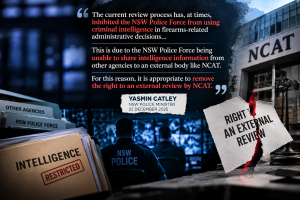
On 22 December 2025, NSW Police Minister Yasmin Catley justified abolishing independent NCAT review of firearms licensing decisions by claiming that the existing process inhibited police from using criminal intelligence.
But the published tribunal record tells a different story. NSW Police had already used criminal intelligence in firearms licensing matters, and NCAT had considered confidential intelligence in reviewing those decisions.
The cases listed below document that practice and raise serious questions about the Minister’s justification. If criminal intelligence was already being used and considered, why was abolishing independent review necessary?
If confidential intelligence could be handled within the tribunal system, what specific barrier required the removal of independent review rights?
Tribunal case library
Browse a selected set of published tribunal decisions classified by the research dataset as involving criminal intelligence in firearms-related matters. Classification is research-derived and does not independently establish what evidence was admitted in each proceeding.
76 verified and approved cases
McLennan v Commissioner of Police [2021] NSWCATAD 232
2021-08-11 Outcome not classified NSW Police Force
Closed hearing recorded
View case details
Outcome
What the Tribunal decided and orders made
Firearms licence refusal affirmed.
Orders
- The decision under review is affirmed.
Protected information
How confidential or protected intelligence was used
The Commissioner presented additional confidential information during the substantive hearing and sought section 64 restrictions to protect the source. The Tribunal granted the orders and conducted part of the hearing in private without the applicant. The published judgment marks four paragraphs “[Not for publication]” and states that section 64 restrictions apply to confidentially filed material, private evidence and the record of the private hearing; the material must not be released to the applicant or public. The public reasons independently discuss the applicant’s criminal and traffic history as grounds for refusal. The confidential material was received and considered, but the publicly available reasons do not establish that it was independently decisive.
Mechanisms employed
- Closed hearing
- Applicant excluded
- Non-publication order
- Non-disclosure / restricted disclosure
- Confidential evidence received
- Confidential evidence considered
Legal framework
Legislation and statutory mechanisms
Firearms Act 1996 (NSW), ss 3 and 11(7) — public safety and discretionary refusal in the public interest. Administrative Decisions Review Act 1997 (NSW), s 63 — merits review. Civil and Administrative Tribunal Act 2013 (NSW), ss 49 and 64 — private hearing and restrictions on publication and disclosure.
AI-assisted editorial summary. Refer to the official decision for authoritative reasons and orders.
Mekhitarian v Commissioner of Police [2021] NSWCATAD 309
2021-10-25 Outcome not classified NSW Police Force
Closed hearing recorded
View case details
Outcome
What the Tribunal decided and orders made
Five confidentiality orders granted; substantive licence revocation not decided.
Orders
- Under section 49(2) of the Civil and Administrative Tribunal Act 2013 (NSW), the hearing of this application is to be conducted without the applicant, the applicant’s legal representative or the public.
- Under section 59 of the Administrative Decisions Review Act 1997 (NSW), the Commissioner need not lodge copies of the Confidential Material specified in the Confidential Affidavit under section 58.
- Under section 64(1)(c) of the NCAT Act, publication of the Confidential Material, the Confidential Affidavit and matters contained in them is prohibited.
- Under section 64(1)(d) of the NCAT Act, disclosure of that material is restricted to the Commissioner, the Commissioner’s legal representatives and the Tribunal.
- Under sections 64(1)(b) and (c) of the NCAT Act, publication and reporting of the hearing of this application, including evidence given during it, is prohibited.
Protected information
How confidential or protected intelligence was used
The Commissioner submitted a confidential affidavit and sought protection for specified police intelligence. The Tribunal assessed the confidentiality application and granted a private hearing, document-lodgement exemption, non-publication and restricted-disclosure orders. The applicant, the applicant’s legal representative and the public were excluded from the hearing of this application. The Tribunal recognised that restrictions on access to evidence engage procedural fairness, but accepted the grounds for confidentiality. The public judgment does not reveal the protected information. This procedural decision does not establish that the confidential intelligence was relied upon to decide the licence revocation.
Mechanisms employed
- Closed hearing
- Applicant excluded
- Legal representative excluded
- Public excluded
- Non-publication order
- Non-disclosure / restricted disclosure
- Exemption from lodging confidential copies
- Confidential evidence received
- Confidential evidence considered
Legal framework
Legislation and statutory mechanisms
Firearms Act 1996 (NSW) — underlying Category AB licence revocation. Administrative Decisions Review Act 1997 (NSW), ss 58–59 — document-lodgement requirements and exemption. Civil and Administrative Tribunal Act 2013 (NSW), ss 38(2), 49(2), 64(1)(b)–(d) — natural justice, private hearing, non-publication and restricted disclosure.
AI-assisted editorial summary. Refer to the official decision for authoritative reasons and orders.
Mekhitarian v Commissioner of Police [2022] NSWCATAD 198
2022-06-15 Set Aside NSW Police Force
Closed hearing recorded
View case details
Outcome
What the Tribunal decided and orders made
Revocation set aside.
Orders
- The decision under review is set aside.
Protected information
How confidential or protected intelligence was used
The Commissioner relied on a confidential intelligence affidavit dated 21 September 2021. The applicant was not informed of its details under confidentiality orders. The Commissioner confirmed that the protected material did not allege misconduct by the applicant and did not contest the applicant’s fitness and propriety. The published decision restricts release of the confidential hearing transcript, recording, exhibits and protected paragraphs under section 64(1)(c) and (d) of the Civil and Administrative Tribunal Act 2013 (NSW). The Tribunal ultimately set aside the revocation; the precise weight of confidential evidence is not stated in the public passages.
Mechanisms employed
- Closed hearing
- Non-publication order
- Non-disclosure / restricted disclosure
- Confidential evidence received
- Confidential evidence considered
Legal framework
Legislation and statutory mechanisms
Firearms Act 1996 (NSW), s 24(2)(d): revocation on prescribed grounds; Firearms Regulation 2006 (NSW), cl 20: public-interest revocation ground identified in the judgment; Administrative Decisions Review Act 1997 (NSW), s 58: lodged review material; Civil and Administrative Tribunal Act 2013 (NSW), s 64: non-publication and non-disclosure protections.
AI-assisted editorial summary. Refer to the official decision for authoritative reasons and orders.
Mercer v Commissioner of Police, NSW Police (No 2) [2007] NSWADT 250
2007-10-15 Affirmed Commissioner of Police, NSW Police
Closed hearing recorded
View case details
Outcome
What the Tribunal decided and orders made
Firearms licence revocation affirmed.
Orders
- The decision of the Commissioner to revoke the applicant’s firearms licence is affirmed.
Protected information
How confidential or protected intelligence was used
Under section 75(5) of the Firearms Act and section 75 of the ADT Act the Tribunal received protected intelligence and heard submissions in the absence of the applicant, their legal representative and the public. The reasons contain suppressed paragraphs. The Tribunal expressly considered and relied on confidential material, although it reduced the weight assigned because the applicant could not cross-examine or respond.
Mechanisms employed
- Closed hearing
- Applicant excluded
- Legal representative excluded
- Public excluded
- Non-publication order
- Non-disclosure / restricted disclosure
- Confidential evidence received
- Confidential evidence considered
- Confidential evidence relied upon
Legal framework
Legislation and statutory mechanisms
Firearms Act 1996 (NSW), ss 24 and 75(5); Administrative Decisions Tribunal Act 1997 (NSW), s 75; Firearms Regulation 2006 (NSW).
AI-assisted editorial summary. Refer to the official decision for authoritative reasons and orders.
Metleg v Commissioner of Police, NSW Police Force [2023] NSWCATAD 17
2023-01-18 Outcome not classified NSW Police Force
Closed hearing recorded
View case details
Outcome
What the Tribunal decided and orders made
Decision affirmed.
The Tribunal affirmed the NSW Police Commissioner's refusal to grant the applicant a Category A and B firearms licence.
The Tribunal was not satisfied that the applicant met the statutory fitness and propriety requirements and concluded that granting the licence would be contrary to the public interest.
The applicant had no criminal convictions. The refusal was based on the Tribunal's assessment of public-safety risk, including continuing family associations, conduct relevant to regulatory compliance and concerns about responsible control of firearms.
The Tribunal considered confidential police evidence but did not rely solely on that material to reach its decision.
Orders
- The decision under review is affirmed.
- Pursuant to sections 64(1)(c) and 64(1)(d) of the Civil and Administrative Tribunal Act 2013 (NSW), publication and disclosure of confidential evidence tendered by the Commissioner in the applicant's absence are restricted.
- Pursuant to sections 64(1)(c) and 64(1)(d), the transcript and recording of the confidential hearing, together with paragraphs of the reasons marked "[NOT FOR PUBLICATION]", must not be published or released to the applicant or the public.
- Pursuant to section 49 of the Civil and Administrative Tribunal Act 2013 (NSW), the transcript and recording of the remaining portion of the hearing held on 21 March 2022 must not be published or released to the public.
Protected information
How confidential or protected intelligence was used
The proceedings involved confidential police information protected by statutory restrictions on disclosure, publication and public access.
In a related interlocutory decision in December 2021, the Tribunal made orders protecting confidential documents, a confidential affidavit, the record of a private hearing and specified passages of its reasons.
At the substantive hearing, the Tribunal excluded the public. The applicant and legal representatives were also excluded from the portion in which confidential police evidence and submissions were received.
The Tribunal recorded the applicant's consent to these arrangements. Nevertheless, the applicant did not have access to the protected evidence considered during the confidential portion of the proceedings.
The Tribunal received confidential affidavits and associated exhibits. It did not reproduce their contents in the published reasons.
The Tribunal considered the confidential material when determining the application but indicated that it was not necessary to rely solely on that evidence to affirm the Commissioner's decision.
Orders under sections 49 and 64 of the Civil and Administrative Tribunal Act 2013 (NSW) restricted publication and disclosure of confidential evidence, designated passages of the reasons, hearing transcripts and recordings.
This summary does not reproduce protected evidence, disclose confidential sources or attempt to reconstruct suppressed material. Personal names have also been anonymised as an editorial privacy measure.
Mechanisms employed
- Closed hearing
- Applicant excluded
- Legal representative excluded
- Public excluded
- Non-publication order
- Non-disclosure / restricted disclosure
- Exemption from lodging confidential copies
- Confidential evidence considered
Legal framework
Legislation and statutory mechanisms
Firearms Act 1996 (NSW)
- Section 3: Establishes public safety as the overriding principle of firearms regulation.
- Section 11(3)(a): Requires satisfaction that an applicant is a fit and proper person who can be trusted to possess firearms without danger to public safety or the peace.
- Section 11(7): Provides for refusal of a licence where granting it would be contrary to the public interest.
- Section 75: Provides for administrative review of relevant firearms licensing decisions.
Administrative Decisions Review Act 1997 (NSW)
- Section 9: Relevant to the Tribunal's administrative review jurisdiction.
- Section 58: Governs the lodgement of documents relevant to an administrative review.
- Section 59: Allows the Tribunal to exempt an administrator from lodging specified confidential documents.
- Section 63: Requires the Tribunal to determine the correct and preferable decision.
Civil and Administrative Tribunal Act 2013 (NSW)
- Section 49: Enables private hearing arrangements and exclusion of specified persons.
- Section 64(1)(b): Enables restrictions on publication or reporting of proceedings.
- Section 64(1)(c): Enables restrictions on publication of evidence and documentary material.
- Section 64(1)(d): Enables restrictions on disclosure of evidence or information to parties or other persons.
Related decision
[2021] NSWCATAD 358 — interlocutory confidentiality decision involving exemptions from document lodgement and restrictions on publication and disclosure.
AI-assisted editorial summary. Refer to the official decision for authoritative reasons and orders.
Neubeck v Commissioner of Police [2021] NSWCATAD 221
2021-07-27 Outcome not classified NSW Police Force
Closed hearing recorded
View case details
Outcome
What the Tribunal decided and orders made
Five confidentiality orders granted; substantive licence revocation not determined.
Orders
- Under section 49 of the Civil and Administrative Tribunal Act 2013 (NSW), the substantive hearing, insofar as it relates to the Confidential Material, is to be conducted without the applicant, the applicant’s legal representatives and the public.
- Under section 59 of the Administrative Decisions Review Act 1997 (NSW), the Commissioner need not lodge copies of specified Confidential Material described in the Confidential Statement (confidential exhibit CR3).
- Under section 64(1)(c) of the NCAT Act, publication of the Confidential Material, confidential exhibit CR3 and matters contained in them is prohibited.
- Under section 64(1)(d) of the NCAT Act, disclosure of the Confidential Material, confidential exhibit CR3 and matters contained in them is restricted to the Commissioner, the Commissioner’s legal representatives and the Tribunal.
- Under sections 64(1)(b)–(d) of the NCAT Act, publication and recording of the confidential preliminary hearing and its evidence are prohibited, and paragraphs marked not for publication must not be published or released to the applicant.
Protected information
How confidential or protected intelligence was used
The Commissioner tendered a confidential police statement (exhibit CR3) and other documents in an ex parte telephone hearing. Police argued that disclosure could reveal informants, third-party personal information, intelligence holdings, investigations and police methods. The Tribunal accepted the grounds for protection, acknowledged the implications for natural justice and open justice, and made orders under sections 49 and 64 of the NCAT Act and section 59 of the Administrative Decisions Review Act. The applicant and their representatives were excluded from the protected portion of the later substantive hearing. The confidential material was received and considered for this procedural application; the Tribunal did not decide its probative weight on the licence revocation merits.
Mechanisms employed
- Closed hearing
- Applicant excluded
- Legal representative excluded
- Public excluded
- Non-publication order
- Non-disclosure / restricted disclosure
- Exemption from lodging confidential copies
- Confidential evidence received
- Confidential evidence considered
Legal framework
Legislation and statutory mechanisms
Firearms Act 1996 (NSW) — underlying Category AB revocation. Administrative Decisions Review Act 1997 (NSW), ss 53(9)(b), 58–59 — internal review and document-lodgement exemption. Civil and Administrative Tribunal Act 2013 (NSW), ss 49(1)–(2), 64(1)(b)–(d) — private hearings and restrictions on publication and disclosure. Relevant authority: Grant v Commissioner of Police [2020] NSWCATAD 158.
AI-assisted editorial summary. Refer to the official decision for authoritative reasons and orders.
Newman v Commissioner of Police, NSW Police Force [2018] NSWCATAD 17
2018-01-22 Set Aside NSW Police Force
Closed hearing recorded
View case details
Outcome
What the Tribunal decided and orders made
Category AB firearms licence revocation set aside; further direction concerning any future Category H application.
Orders
- The decision under review is set aside.
- If the applicant applies for a Category H licence for sport/target shooting, the Commissioner is directed to have regard to the findings in this decision when considering that application.
Protected information
How confidential or protected intelligence was used
The Commissioner provided confidential documents and evidence during a closed hearing on 15 November 2017 attended only by the Commissioner’s representatives and witnesses. The applicant, their representative and public were absent. Section 64 publication restrictions applied to confidential documents received in evidence, evidence and submissions at the confidential hearing, later confidential documents and paragraphs marked “[NOT FOR PUBLICATION]”. The Tribunal received and considered the confidential material but concluded there was no cogent open or confidential evidence personally implicating the applicant in criminal activity. The revocation was set aside. The protected evidence must not be reproduced or reconstructed.
Mechanisms employed
- Closed hearing
- Applicant excluded
- Legal representative excluded
- Public excluded
- Non-publication order
- Confidential evidence received
- Confidential evidence considered
Legal framework
Legislation and statutory mechanisms
Firearms Act 1996 (NSW), ss 3, 11, 24 and 75(1)(c) — public safety, licensing, revocation and review. Administrative Decisions Review Act 1997 (NSW), s 63 — correct and preferable decision. Civil and Administrative Tribunal Act 2013 (NSW), ss 49 and 64 — closed hearing and restrictions on publication of confidential evidence. Firearms Regulation 2006 (NSW), cl 19 — regulatory public-interest considerations applicable at the time.
AI-assisted editorial summary. Refer to the official decision for authoritative reasons and orders.
Nguyen v Commissioner of Police, NSW Police [2007] NSWADT 16
2007-01-17 Outcome not classified Commissioner of Police, NSW Police
Closed hearing recorded
View case details
Outcome
What the Tribunal decided and orders made
Category H firearms licence refusal affirmed.
Orders
- The Commissioner’s decision to refuse the applicant a Category H firearms licence is affirmed.
Protected information
How confidential or protected intelligence was used
The Tribunal heard a police witness and received confidential material under section 75 of the ADT Act in the applicant’s absence, with the applicant’s agreement. It expressly stated that weight was given to that material. Portions of the published reasons are marked subject to suppression order. The text does not establish that a legal representative was excluded: the applicant appeared in person.
Mechanisms employed
- Closed hearing
- Applicant excluded
- Non-publication order
- Non-disclosure / restricted disclosure
- Confidential evidence received
- Confidential evidence considered
- Confidential evidence relied upon
Legal framework
Legislation and statutory mechanisms
Firearms Act 1996 (NSW), ss 11(3)(a), 11(5)(b), 11(7); Administrative Decisions Tribunal Act 1997 (NSW), s 75; Firearms (General) Regulation 1997 (NSW), reg 5.
AI-assisted editorial summary. Refer to the official decision for authoritative reasons and orders.
Pemberton v Commissioner of Police [2022] NSWCATAD 109
2022-04-01 Outcome not classified NSW Police Force
Closed hearing recorded
View case details
Outcome
What the Tribunal decided and orders made
Interlocutory confidentiality orders granted; licence refusal not determined.
Orders
- Under section 49 of the Civil and Administrative Tribunal Act 2013 (NSW), the substantive hearing, insofar as it relates to Confidential Documents or Confidential Evidence, is to be conducted without the applicant, any legal representative for the applicant and the public.
- Under section 59 of the Administrative Decisions Review Act 1997 (NSW), the Commissioner is exempt from lodging copies of the Confidential Documents specified in the Confidential Statement.
- Under section 64(1)(c) of the Civil and Administrative Tribunal Act 2013 (NSW), publication of evidence given during the private hearing, the Confidential Documents, the Confidential Statement and their contents is prohibited.
- Under section 64(1)(d), disclosure of that evidence, those documents, the statement and their contents is restricted to the Commissioner, the Commissioner’s legal representatives and the Tribunal.
- Under sections 64(1)(b) and 64(1)(c), publication and reporting of the private hearing and oral evidence given during it is prohibited.
Protected information
How confidential or protected intelligence was used
The Commissioner sought protection of confidential police documents and a confidential statement. The Tribunal accepted that disclosure was likely to affect ongoing investigations and could reveal police sources. It ordered a private hearing for confidential material only, with applicant, legal representative and public exclusion; an exemption from lodging specified confidential copies; and non-publication and restricted disclosure orders. Additional restrictions protected the transcript, recording and paragraphs marked not for publication. The Tribunal did not make a substantive determination about the licence application in this procedural judgment.
Mechanisms employed
- Closed hearing
- Applicant excluded
- Legal representative excluded
- Public excluded
- Non-publication order
- Non-disclosure / restricted disclosure
- Exemption from lodging confidential copies
- Confidential evidence received
- Confidential evidence considered
Legal framework
Legislation and statutory mechanisms
Civil and Administrative Tribunal Act 2013 (NSW), ss 49, 64(1)(b)–(d); Administrative Decisions Review Act 1997 (NSW), ss 58, 59; Firearms Act 1996 (NSW), licensing review context. Related substantive decision: [2022] NSWCATAD 288.
AI-assisted editorial summary. Refer to the official decision for authoritative reasons and orders.
Pemberton v Commissioner of Police, NSW Police Force [2022] NSWCATAD 288
2022-08-26 Affirmed NSW Police Force
Closed hearing recorded
View case details
Outcome
What the Tribunal decided and orders made
Decision affirmed; firearms licence application refused.
The Tribunal affirmed the Commissioner's refusal to grant the applicant a Category ABC and D firearms licence.
The Tribunal concluded that the applicant's criminal and traffic history, volatile interpersonal relationships, interactions with police and confidential evidence raised public-interest and public-safety concerns.
Although the applicant disputed numerous allegations and relied on the withdrawal or dismissal of apprehended violence order proceedings, the Tribunal considered the broader pattern of conduct relevant to the licensing assessment.
The Tribunal found a real and appreciable risk to public safety and determined that granting the licence would be contrary to the public interest under section 11(7) of the Firearms Act 1996 (NSW).
Orders
- The decision under review is affirmed
Protected information
How confidential or protected intelligence was used
The Commissioner relied on a confidential police affidavit dated 15 February 2022 and supporting confidential documents.
In the related interlocutory decision [2022] NSWCATAD 109, the Tribunal authorised a private hearing for the portions of the substantive proceedings involving confidential documents or evidence.
Under section 49 of the Civil and Administrative Tribunal Act 2013 (NSW), the applicant, any legal representative for the applicant and the public were excluded from those confidential portions of the hearing.
Under section 59 of the Administrative Decisions Review Act 1997 (NSW), the Commissioner was exempted from lodging specified confidential documents through the ordinary document-lodgement process.
The Tribunal also made orders under section 64 of the Civil and Administrative Tribunal Act 2013 (NSW) prohibiting publication of confidential evidence and restricting disclosure to the Commissioner, the Commissioner's legal representatives and the Tribunal.
The confidentiality ruling identified the protection of police sources and ongoing investigations as relevant considerations. It expressly recognised the tension between confidentiality, open justice and procedural fairness.
In the substantive judgment, the Tribunal considered the confidential evidence alongside the applicant's criminal history, traffic record, family disputes and interactions with police.
The published reasons contain paragraphs marked "[Not for publication]". The substantive decision also restricts publication or release of the confidential hearing transcript, recording, exhibits and protected paragraphs.
The applicant was unable to examine or challenge the specified protected material in the ordinary manner. The public judgment does not disclose the material's contents or establish its precise individual contribution to the outcome.
No protected evidence or identifying information from the confidential affidavit is reproduced in this summary.
Mechanisms employed
- Closed hearing
- Applicant excluded
- Legal representative excluded
- Public excluded
- Non-publication order
- Confidential evidence received
Legal framework
Legislation and statutory mechanisms
Firearms Act 1996 (NSW)
Section 3 — Establishes public safety as the overriding principle of firearms regulation and recognises that firearms possession and use are conditional privileges.
Section 11(7) — Permits refusal of a firearms licence where granting the licence would be contrary to the public interest.
Firearms Regulation 2017 (NSW)
Forms part of the regulatory framework governing firearms licensing, genuine reasons and related requirements.
Administrative Decisions Review Act 1997 (NSW)
Section 58 — Governs the ordinary lodgement of relevant documents in administrative review proceedings.
Section 59 — Permits exemption from ordinary document-lodgement requirements. This provision was used in the related confidentiality decision.
Section 63 — Requires the Tribunal to determine the correct and preferable decision on administrative review.
Civil and Administrative Tribunal Act 2013 (NSW)
Section 38(2) — Provides for the Tribunal's inquiry into relevant matters, subject to the rules of natural justice.
Section 49(1)–(2) — Establishes the general rule of open hearings and permits private hearings in appropriate circumstances.
Section 64(1)(b) — Permits restrictions on publication or reporting of proceedings.
Section 64(1)(c) — Permits restrictions on publication of evidence and documents.
Section 64(1)(d) — Permits restrictions on disclosure of evidence or documents to parties.
Crimes (Sentencing Procedure) Act 1999 (NSW)
Included among the legislation cited in the substantive judgment in connection with the applicant's criminal history.
Relevant authorities include Commissioner of Police v Toleafoa [1999] NSWADTAP 9, Joseph v Commissioner of Police [2017] NSWCA 31, Nakad v Commissioner of Police [2014] NSWCATAP 10 and Webb v Commissioner of Police [2004] NSWADT 110.
Related procedural decision: Pemberton v Commissioner of Police [2022] NSWCATAD 109.
AI-assisted editorial summary. Refer to the official decision for authoritative reasons and orders.
Pendrick v Commissioner of Police, NSW Police Force [2021] NSWCATAD 326
2021-11-05 Outcome not classified NSW Police Force
No closed-hearing flag in this dataset
View case details
Outcome
What the Tribunal decided and orders made
Document-lodgement exemption granted; limited non-publication and non-disclosure orders made; remainder of application dismissed. Licence refusals not determined.
Orders
- A hearing of the Commissioner’s applications under section 59 of the Administrative Decisions Review Act 1997 (NSW) and sections 49 and 64 of the Civil and Administrative Tribunal Act 2013 (NSW) is dispensed with.
- 1A. Under section 59 of the Administrative Decisions Review Act 1997 (NSW), copies of the Confidential Material identified in the Commissioner’s application of 18 August 2021 need not be lodged with the Tribunal.
- Disclosure to either applicant of the confidential affidavit filed on 27 September 2021 and its contents is prohibited.
- Publication of that confidential affidavit and its contents is prohibited.
- Disclosure to either applicant of the Confidential Material identified in the application of 18 August 2021 and its contents is prohibited pending further order.
- Publication of that Confidential Material and its contents is prohibited pending further order.
- The Commissioner’s application of 18 August 2021 is otherwise dismissed.
Protected information
How confidential or protected intelligence was used
The Commissioner lodged a confidential affidavit and supplied protected material for consideration of confidentiality requests. The Tribunal found that some material attracted public interest immunity and that other material could warrant non-publication if tendered at a later hearing. It granted an exemption under section 59 and temporary non-publication and non-disclosure protections, but refused broader orders at this stage. The matter was determined on the papers, not in a closed oral hearing. The Tribunal specifically reserved final restrictions on any material admitted as evidence for the substantive hearing. Receipt of material for this procedural application must not be misclassified as substantive evidentiary reliance.
Mechanisms employed
- Non-publication order
- Non-disclosure / restricted disclosure
- Exemption from lodging confidential copies
- Confidential evidence received
- Confidential evidence considered
Legal framework
Legislation and statutory mechanisms
Administrative Decisions Review Act 1997 (NSW), ss 53(6), 53(9), 55(3), 58 and 59 — review access and document-lodgement exemption. Civil and Administrative Tribunal Act 2013 (NSW), ss 49, 50(2) and 64 — hearings on the papers, private-hearing powers and protective orders. Firearms Act 1996 (NSW) — underlying licence refusals. Public interest immunity was relevant to the section 59 determination.
AI-assisted editorial summary. Refer to the official decision for authoritative reasons and orders.
Pittorino v Commissioner of Police (No 2) [2022] NSWCATAD 166
2022-05-25 Outcome not classified NSW Police Force
Closed hearing recorded
View case details
Outcome
What the Tribunal decided and orders made
Refusal of Category AB firearms licence affirmed.
Orders
- The Commissioner’s decision to refuse the applicant’s application for a firearms licence is affirmed.
Protected information
How confidential or protected intelligence was used
The related interlocutory decision [2021] NSWCATAD 350 authorised confidentiality protections. The substantive hearing included a confidential part conducted in the applicant’s absence, and the Commissioner relied on confidential evidence and submissions. The substantive judgment records restrictions on disclosure and publication of the Confidential Statement, Confidential Submissions, private-hearing transcript and record, and paragraph 22 marked not for publication. The public reasons discuss the applicant’s traffic history and associations independently of the protected material. The precise protected contents must not be inferred. The public text establishes confidential material was relied on by the Commissioner; the Tribunal’s precise weight given to it in its ultimate reasoning is not independently established.
Mechanisms employed
- Closed hearing
- Applicant excluded
- Public excluded
- Non-publication order
- Non-disclosure / restricted disclosure
- Confidential evidence received
- Confidential evidence considered
Legal framework
Legislation and statutory mechanisms
Firearms Act 1996 (NSW), ss 3, 11(4)(a), 11(7), 75(1)(a); Administrative Decisions Review Act 1997 (NSW), ss 53(9)(b), 63; Civil and Administrative Tribunal Act 2013 (NSW), ss 49, 64(1)(b)–(d). Related interlocutory decision: [2021] NSWCATAD 350.
AI-assisted editorial summary. Refer to the official decision for authoritative reasons and orders.
Pittorino v Commissioner of Police [2021] NSWCATAD 350
2021-11-22 Outcome not classified NSW Police Force
Closed hearing recorded
View case details
Outcome
What the Tribunal decided and orders made
Confidentiality application granted in part; redacted disclosure ordered; substantive licence refusal not determined.
Orders
- By 23 November 2021, the Commissioner must lodge and serve the specified document in its approved redacted form.
- Under section 59 of the Administrative Decisions Review Act 1997 (NSW), the Commissioner is exempt from lodging the other documents specified in the Confidential Statement.
- Disclosure of the Confidential Statement and Confidential Submissions is restricted to the Commissioner, legal representatives and Tribunal under section 64(1)(d) of the Civil and Administrative Tribunal Act 2013 (NSW).
- Publication of the Confidential Statement and Confidential Submissions is prohibited under section 64(1)(c).
- Publication of the transcript and record of the private portion of the application hearing is prohibited under section 64(1)(b).
- Disclosure of the transcript and record of that private hearing is restricted under section 64(1)(d).
- Disclosure of the Confidential Material, including the withheld documents and redacted portions, is restricted to the Commissioner, legal representatives and Tribunal until further order.
- Publication of the Confidential Material is prohibited until further order.
- Publication or disclosure to the applicant or public of paragraphs marked Not for publication is prohibited.
- The proceedings are listed for further directions on 30 November 2021 at 10:30 am at John Maddison Tower, Sydney.
Protected information
How confidential or protected intelligence was used
The Commissioner submitted a confidential statement, confidential submissions and police intelligence records. The Tribunal held part of the application hearing privately in the applicant’s absence and reviewed the protected documents to assess risks to police methods, informants and third-party privacy. It directed disclosure of one document with redactions and exempted the remaining specified documents from ordinary lodgement. Section 64 orders restricted publication and disclosure of confidential materials, private hearing records and protected passages, some until further order. The published judgment does not expressly establish exclusion of a legal representative from the private hearing; the applicant was self-represented. The ruling reserved for the substantive Tribunal whether confidential material should later be received or relied on to decide the licence application.
Mechanisms employed
- Closed hearing
- Applicant excluded
- Public excluded
- Non-publication order
- Non-disclosure / restricted disclosure
- Exemption from lodging confidential copies
- Confidential evidence received
- Confidential evidence considered
Legal framework
Legislation and statutory mechanisms
Firearms Act 1996 (NSW), s 11(7); Administrative Decisions Review Act 1997 (NSW), ss 53(9)(b), 58, 59; Civil and Administrative Tribunal Act 2013 (NSW), ss 38(2), 49(2), 64(1)(b)–(d).
AI-assisted editorial summary. Refer to the official decision for authoritative reasons and orders.
Pollard v Commissioner of Police, NSW Police Force [2021] NSWCATAD 227
2021-08-09 Outcome not classified NSW Police Force
No closed-hearing flag in this dataset
View case details
Outcome
What the Tribunal decided and orders made
Extension of time granted; non-publication and non-disclosure orders made; section 59 application deferred. Licence revocation merits not determined.
Orders
- The time for the applicant to lodge an application for administrative review of the firearms licence revocation is extended to 3 June 2021.
- Under section 64(1)(d) of the Civil and Administrative Tribunal Act 2013 (NSW), disclosure to the applicant of the Commissioner’s confidential submissions, confidential police statement and information report filed pursuant to the earlier order of 29 June 2021 is prohibited.
- Under section 64(1)(c) of that Act, publication of those confidential submissions, confidential statement and information report is prohibited.
- The Commissioner’s section 59 application under the Administrative Decisions Review Act 1997 (NSW) is deferred for determination at the hearing on 19 August 2021.
Protected information
How confidential or protected intelligence was used
The Commissioner filed confidential submissions and a confidential police statement in support of protecting an information report. The Tribunal granted non-publication and non-disclosure orders under section 64(1)(c)–(d) of the NCAT Act. The section 59 exemption was NOT granted: the Tribunal deferred it after distinguishing withholding a document from the Tribunal entirely from lodging it confidentially while denying applicant access. The matter was decided on the papers, not at a closed oral hearing. The material was received and considered for this procedural ruling, but was not relied upon to determine the substantive revocation.
Mechanisms employed
- Non-publication order
- Non-disclosure / restricted disclosure
- Confidential evidence received
- Confidential evidence considered
Legal framework
Legislation and statutory mechanisms
Firearms Act 1996 (NSW), s 75(1)(c) — reviewable revocation. Administrative Decisions Review Act 1997 (NSW), ss 53(9), 55(2), 58, 59, 63 — deemed internal review, application, lodgement, exemption and merits review. Civil and Administrative Tribunal Act 2013 (NSW), ss 41, 50(2), 64(1)(c)–(d) — extension of time, decision on papers, non-publication and non-disclosure. Civil and Administrative Tribunal Rules 2014 (NSW), r 24 — time limit.
AI-assisted editorial summary. Refer to the official decision for authoritative reasons and orders.
Ryan v Commissioner of Police [2021] NSWCATAD 23
2021-02-05 Outcome not classified NSW Police Force
Closed hearing recorded
View case details
Outcome
What the Tribunal decided and orders made
Category AB licence revocation and Category H licence refusal affirmed.
Orders
- The decision under review is affirmed.
Protected information
How confidential or protected intelligence was used
The Commissioner tendered confidential police Information Reports and COPS reports, including evidence given in a closed session under sections 49 and 64 of the Civil and Administrative Tribunal Act 2013 (NSW). Earlier orders made on 7 October 2020 under section 59 of the Administrative Decisions Review Act 1997 (NSW) and section 64 of the NCAT Act protected specified reports. The substantive judgment includes several “[Not for publication]” paragraphs and a publication restriction on confidential hearing records and protected reasons. The Tribunal considered the protected intelligence in its assessment of the applicant’s domestic circumstances and criminal associations. The publicly available reasons give independent grounds for affirmance based on the partner’s criminal history and contradictory safekeeping information; the precise weight assigned to the protected material is not separately quantified. The public reasons do not establish that applicant and legal representative exclusion orders were made, and those checkboxes should not be selected without the earlier procedural order.
Mechanisms employed
- Closed hearing
- Non-publication order
- Non-disclosure / restricted disclosure
- Exemption from lodging confidential copies
- Confidential evidence received
- Confidential evidence considered
Legal framework
Legislation and statutory mechanisms
Firearms Act 1996 (NSW), ss 3, 11(4)(a), 11(7), 24(2)(a), 24(2)(d) — public safety, domestic circumstances, public-interest refusal and revocation. Firearms Regulation 2017 (NSW), cl 20 — public-interest revocation. Administrative Decisions Review Act 1997 (NSW), ss 53(9)(b), 58–59, 63 — deemed internal review, document exemption and merits review. Civil and Administrative Tribunal Act 2013 (NSW), ss 28(2), 38(2), 49, 64 — evidence, natural justice, private hearing and disclosure restrictions.
AI-assisted editorial summary. Refer to the official decision for authoritative reasons and orders.
Research and legal notice: This is a selected, non-exhaustive research dataset, not a representative sample of all tribunal matters. AI-assisted classification may contain errors. Nothing here constitutes legal advice. Case titles are reproduced unchanged as public legal citations; this is not full anonymisation. Source decisions should be checked before drawing conclusions.