CRIMINAL INTELLIGENCE. NCAT. THE DOCUMENTED RECORD
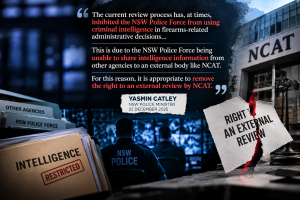
On 22 December 2025, NSW Police Minister Yasmin Catley justified abolishing independent NCAT review of firearms licensing decisions by claiming that the existing process inhibited police from using criminal intelligence.
But the published tribunal record tells a different story. NSW Police had already used criminal intelligence in firearms licensing matters, and NCAT had considered confidential intelligence in reviewing those decisions.
The cases listed below document that practice and raise serious questions about the Minister’s justification. If criminal intelligence was already being used and considered, why was abolishing independent review necessary?
If confidential intelligence could be handled within the tribunal system, what specific barrier required the removal of independent review rights?
Tribunal case library
Browse a selected set of published tribunal decisions classified by the research dataset as involving criminal intelligence in firearms-related matters. Classification is research-derived and does not independently establish what evidence was admitted in each proceeding.
76 verified and approved cases
Salameh v Commissioner of Police, NSW Police Force [2023] NSWCATAD 148
2023-06-14 Affirmed NSW Police Force
No closed-hearing flag in this dataset
View case details
Outcome
What the Tribunal decided and orders made
Affirmed
Orders
- The decision under review is affirmed.
Protected information
How confidential or protected intelligence was used
The published reasons refer to a confidential affidavit and identify passages subject to restrictions under s 64 of the Civil and Administrative Tribunal Act 2013 (NSW). At paragraph 37, the Tribunal expressly refers to its observations concerning confidential material as part of its reasoning. Restricted passages are not reproduced.
Mechanisms employed
- Non-publication order
- Confidential evidence considered
- Confidential evidence relied upon
Legal framework
Legislation and statutory mechanisms
- Administrative Decisions Review Act 1997 (NSW)
- Civil and Administrative Tribunal Act 2013 (NSW)
- Crimes (Sentencing Procedure) Act 1999 (NSW)
- Firearms Act 1996 (NSW)
AI-assisted editorial summary. Refer to the official decision for authoritative reasons and orders.
Salter v Commissioner of Police [2021] NSWCATAD 37
2021-02-25 Affirmed NSW Police Force
Closed hearing recorded
View case details
Outcome
What the Tribunal decided and orders made
Firearms prohibition order affirmed.
Orders
- The reviewable decision is affirmed.
Protected information
How confidential or protected intelligence was used
Confidentiality orders had been made in earlier interlocutory proceedings for confidential police and AFP material. They authorised private hearings excluding the applicant and the applicant’s legal representative, exempted the Commissioner from lodging specified confidential copies and restricted publication and disclosure to the Commissioner, the Commissioner’s legal representatives and the Tribunal. The substantive Tribunal received further confidential evidence in private and marked several paragraphs “[Not for publication]”. It expressly assigned significant weight to the confidential material and relied on it to find ongoing public-interest concerns. The applicant argued that undisclosed evidence undermined the opportunity to challenge allegations, but the Tribunal treated section 64(1)(d) as a statutory qualification to ordinary procedural fairness. Earlier confidentiality orders are described here but are not additional operative orders of this substantive judgment.
Mechanisms employed
- Closed hearing
- Applicant excluded
- Legal representative excluded
- Public excluded
- Non-publication order
- Non-disclosure / restricted disclosure
- Exemption from lodging confidential copies
- Confidential evidence received
- Confidential evidence considered
- Confidential evidence relied upon
Legal framework
Legislation and statutory mechanisms
Firearms Act 1996 (NSW), ss 3, 73(1), 74A, 75(1)(f) — public safety, firearms prohibition orders, search powers and review. Administrative Decisions Review Act 1997 (NSW), ss 59, 63 — document-lodgement exemption and merits review. Civil and Administrative Tribunal Act 2013 (NSW), ss 38(2), 49, 64(1)(b)–(d) — natural justice, private hearing, non-publication and restricted disclosure. Briginshaw v Briginshaw (1938) 60 CLR 336 and Grant v Commissioner of Police [2020] NSWCATAD 158 are relevant to proof and confidential evidence.
AI-assisted editorial summary. Refer to the official decision for authoritative reasons and orders.
Sciberras v Commissioner of Police New South Wales Police Force [2015] NSWCATAD 206
2015-10-13 Set Aside Commissioner of Police NSW Police Force
Closed hearing recorded
View case details
Outcome
What the Tribunal decided and orders made
Revocation set aside; licence reinstatement directed subject to special conditions and statutory prerequisites.
Orders
- The decision under review is set aside.
- In substitution, the Commissioner is to reinstate the applicant’s licence with the special conditions referred to in the decision of 1 August 2014 and reproduced at paragraph 9 of the reasons.
- Reinstatement is contingent on the applicant satisfying the Commissioner afresh of any nominated item in the table to section 12 of the Firearms Act 1996.
Protected information
How confidential or protected intelligence was used
After the open hearing, the Tribunal conducted a confidential session under section 75(5)(b) of the Firearms Act, in the absence of the applicant, representative and public. Two unredacted police affidavits were tendered as confidential exhibits RC1 and RC2. Several paragraphs of the reasons are expressly marked not for publication, with a section 64 restriction on releasing those paragraphs to the applicant or public. The confidential material was considered; the ultimate decision favoured reinstatement, and the published reasons do not warrant characterising the protected evidence as decisive against the applicant.
Mechanisms employed
- Closed hearing
- Applicant excluded
- Legal representative excluded
- Public excluded
- Non-publication order
- Non-disclosure / restricted disclosure
- Confidential evidence received
- Confidential evidence considered
Legal framework
Legislation and statutory mechanisms
Firearms Act 1996 (NSW), ss 12 and 75(5); Firearms Regulation 2006 (NSW); Civil and Administrative Tribunal Act 2013 (NSW), s 64; Crimes (Criminal Organisations Control) Act 2012 (NSW).
AI-assisted editorial summary. Refer to the official decision for authoritative reasons and orders.
Shawmac Industries Australia Pty Ltd v Commissioner of Police, NSW Police Force [2018] NSWCATAD 279
2018-11-30 Outcome not classified NSW Police Force
Closed hearing recorded
View case details
Outcome
What the Tribunal decided and orders made
Firearms dealer licence refusal set aside.
Orders
- The decision under review is set aside.
Protected information
How confidential or protected intelligence was used
The Commissioner tendered confidential evidence during a closed session pursuant to sections 49 and 64 of the Civil and Administrative Tribunal Act 2013 (NSW). The published reasons contain protected paragraphs and a publication restriction covering confidential exhibit RC1, the hearing transcript and recording, and those paragraphs. The confidential material was received and considered in the merits proceedings. The Tribunal ultimately found in favour of the applicant company; the public reasons do not establish that confidential material was affirmatively relied upon to reach an adverse outcome. The company’s director and other private individuals are anonymised in this summary.
Mechanisms employed
- Closed hearing
- Public excluded
- Non-publication order
- Non-disclosure / restricted disclosure
- Confidential evidence received
- Confidential evidence considered
Legal framework
Legislation and statutory mechanisms
Firearms Act 1996 (NSW), ss 3, 11 and 12 — public safety, licensing and genuine reasons, including business or employment. Weapons Prohibition Act 1998 (NSW) — existing prohibited-weapons dealer permits. Civil and Administrative Tribunal Act 2013 (NSW), ss 49 and 64(1)(c)–(d) — private hearing and restrictions on confidential material. Administrative Decisions Review Act 1997 (NSW), s 63 — correct and preferable decision.
AI-assisted editorial summary. Refer to the official decision for authoritative reasons and orders.
Shoebridge v Commissioner of Police, NSW Police Force (No. 3) [2018] NSWCATAD 110
2018-05-28 Outcome not classified Commissioner of Police, New South Wales Police Force
Closed hearing recorded
View case details
Outcome
What the Tribunal decided and orders made
Mixed GIPA access decision: set aside for documents 1, 16, 34, 36 and 40; varied for documents 23 and 39; affirmed for documents 4, 5, 6, 7, 8, 9, 10, 33 and 35.
Orders
- The decision of the respondent is set aside in respect of documents 1, 16, 34, 36 and 40.
- In substitution for that decision, the respondent is to release the material in scope in those documents within 28 days of publication of the reasons.
- The decision is varied for documents 23 and 39; those documents are to be released after 28 days in the form specified in confidential annexures to the confidential reasons.
- The decision is affirmed for documents 4, 5, 6, 7, 8, 9, 10, 33 and 35.
Protected information
How confidential or protected intelligence was used
The Tribunal received confidential exhibits RC1, RC2 and RC3, including withheld government documents and confidential affidavits, and considered them during a confidential session under section 107 of the GIPA Act. The applicant and representatives were absent from that session. Confidential reasons and annexures addressed material that could not be publicly reproduced. The Tribunal examined the withheld documents directly and relied on them to assess Cabinet-information claims and disclosure exemptions. This is a GIPA statutory confidential hearing rather than a firearms intelligence hearing; a separate section 64 NCAT non-publication or non-disclosure order should not be inferred merely from the confidential session.
Mechanisms employed
- Closed hearing
- Applicant excluded
- Legal representative excluded
- Public excluded
- Confidential evidence received
- Confidential evidence considered
- Confidential evidence relied upon
Legal framework
Legislation and statutory mechanisms
Government Information (Public Access) Act 2009 (NSW), ss 12–15, 105–107 and Schedule 1 clause 2 — public-interest disclosure assessment, Tribunal review, confidential hearing and Cabinet information. Administrative Decisions Review Act 1997 (NSW), s 63 — correct and preferable decision. Civil and Administrative Tribunal Act 2013 (NSW) — general Tribunal framework.
AI-assisted editorial summary. Refer to the official decision for authoritative reasons and orders.
Sobh v Commissioner of Police [2021] NSWCATAD 260
2021-09-07 Outcome not classified NSW Police Force
Closed hearing recorded
View case details
Outcome
What the Tribunal decided and orders made
Five confidentiality orders granted; merits of licence revocation reserved.
Orders
- Under section 49 of the Civil and Administrative Tribunal Act 2013 (NSW), the substantive hearing, insofar as it concerns the Confidential Material, is to be held without the applicant, the applicant’s legal representatives and the public.
- Under section 59 of the Administrative Decisions Review Act 1997 (NSW), the Commissioner need not lodge copies of the Confidential Material specified in the Confidential Statement and supplied as confidential exhibits CR3 and CR4.
- Under section 64(1)(c) of the NCAT Act, publication of the Confidential Material and confidential exhibits CR3 and CR4, and matters contained in them, is prohibited.
- Under section 64(1)(d) of the NCAT Act, disclosure of that material is restricted to the Commissioner, the Commissioner’s legal representatives and the Tribunal.
- Under sections 64(1)(b), (c) and (d) of the NCAT Act, publication and recording of the confidential hearing of the preliminary proceedings and its evidence are prohibited, and protected paragraphs marked “[Not for publication]” must not be published or released to the applicant.
Protected information
How confidential or protected intelligence was used
The Commissioner tendered a confidential statement and confidential exhibits CR3 and CR4 together with open evidence explaining risks of disclosure. The Tribunal considered the material for the confidentiality application and found that disclosure could compromise law enforcement investigations and confidential sources or endanger individuals. The applicant’s representative did not intend to participate in the section 59 application. The orders directed exclusion of the applicant, legal representatives and public from the confidential portion of the later substantive hearing, and protected documents and reasons against publication and disclosure. The interlocutory Tribunal did not decide the substantive licence revocation or assign merits weight to the intelligence.
Mechanisms employed
- Closed hearing
- Applicant excluded
- Legal representative excluded
- Public excluded
- Non-publication order
- Non-disclosure / restricted disclosure
- Exemption from lodging confidential copies
- Confidential evidence received
- Confidential evidence considered
Legal framework
Legislation and statutory mechanisms
Administrative Decisions Review Act 1997 (NSW), ss 58–59 — document lodgement and exemption. Civil and Administrative Tribunal Act 2013 (NSW), ss 38(2), 49(1)–(2), 64(1)(b)–(d) — natural justice, open/private hearings, non-publication and non-disclosure. Firearms Act 1996 (NSW) — underlying licence revocation. Relevant confidentiality authorities include Grant v Commissioner of Police [2020] NSWCATAD 158 and Simring v Commissioner of Police [2009] NSWSC 270.
AI-assisted editorial summary. Refer to the official decision for authoritative reasons and orders.
Talbot v Commissioner of Police, NSW Police Force [2022] NSWCATAD 389
2022-12-05 Outcome not classified NSW Police Force
Closed hearing recorded
View case details
Outcome
What the Tribunal decided and orders made
Decision set aside; licence to be issued
Orders
- The decision under review is set aside.
- A category AB firearms licence is to be issued to the Applicant.
Protected information
How confidential or protected intelligence was used
The Commissioner relied on confidential police information contained in a confidential affidavit.
The Tribunal conducted a confidential hearing and considered protected material as part of the administrative review.
Under section 64 of the Civil and Administrative Tribunal Act 2013 (NSW), the Tribunal imposed restrictions on publication and disclosure of confidential hearing material and specified protected information.
The restrictions prevented release of the protected material to the applicant, the applicant's legal representatives and the public.
These arrangements limited the applicant's and representatives' opportunity to examine and respond to the confidential information.
Despite considering the confidential material, the Tribunal set aside the Commissioner's refusal and ordered that a Category AB firearms licence be issued.
The available public reasons do not disclose the contents of the confidential evidence or establish precisely what weight the Tribunal assigned to it. The favourable outcome should not be interpreted as a finding that all confidential information was false or irrelevant.
This summary does not reproduce confidential material or identify the individuals involved.
Mechanisms employed
- Closed hearing
- Applicant excluded
- Legal representative excluded
- Non-publication order
- Non-disclosure / restricted disclosure
- Confidential evidence relied upon
Legal framework
Legislation and statutory mechanisms
Firearms Act 1996 (NSW)
Section 3 — Establishes public safety as the overriding principle of firearms regulation.
Section 11(3)(a) — Requires satisfaction that an applicant is fit and proper to possess firearms without danger to public safety or the peace.
Section 11(7) — Provides for refusal where granting a firearms licence would be contrary to the public interest.
Firearms Regulation 2017 (NSW)
Forms part of the regulatory framework governing firearms licensing.
Administrative Decisions Review Act 1997 (NSW)
Section 53(9) — Addresses the deemed completion of an internal review where the statutory decision period expires.
Section 63 — Governs the Tribunal's determination of the correct and preferable decision.
Civil and Administrative Tribunal Act 2013 (NSW)
Section 28(2) — Provides that the Tribunal is generally not bound by the rules of evidence.
Section 38(2) — Requires observance of natural justice.
Section 64 — Provides for non-publication and non-disclosure orders protecting confidential evidence and hearing material.
AI-assisted editorial summary. Refer to the official decision for authoritative reasons and orders.
Tannous v Commissioner of Police, NSW Police Force [2018] NSWCATAD 244
2018-10-19 Outcome not classified NSW Police Force
Closed hearing recorded
View case details
Outcome
What the Tribunal decided and orders made
Category ABH firearms licence revocation affirmed.
Orders
- The Respondent’s decision is affirmed.
Protected information
How confidential or protected intelligence was used
The Commissioner obtained an order under section 64 of the Civil and Administrative Tribunal Act 2013 (NSW) permitting confidential evidence and a private hearing. A confidential document bundle was filed, and the Commissioner made submissions about it in the absence of the applicant and representatives. The published judgment applies section 64 restrictions to confidentially filed material and paragraphs marked not for publication; a third party’s identity was anonymised under section 64(1)(a). The Tribunal referred to information from the confidential session as part of the evidence bearing on its assessment, alongside significant public evidence including contemporaneous video footage. The confidential material’s precise contents are not disclosed.
Mechanisms employed
- Closed hearing
- Applicant excluded
- Legal representative excluded
- Public excluded
- Non-publication order
- Non-disclosure / restricted disclosure
- Confidential evidence received
- Confidential evidence considered
- Confidential evidence relied upon
Legal framework
Legislation and statutory mechanisms
Firearms Act 1996 (NSW), ss 3, 24(2)(c)–(d), 75(1)(c) — public safety, fitness and propriety, prescribed revocation grounds and review. Firearms Regulation 2006 (NSW), cl 19 — public-interest revocation provision applicable at the time. Administrative Decisions Review Act 1997 (NSW), ss 58 and 63 — document lodgement and merits review. Civil and Administrative Tribunal Act 2013 (NSW), ss 38(2), 49 and 64(1)(a), (c)–(d) — evidence, private hearing and confidentiality. Crimes Act 1900 (NSW) — context of dismissed assault charges.
AI-assisted editorial summary. Refer to the official decision for authoritative reasons and orders.
Tukel v Combat Sports Authority [2023] NSWCATAD 180
2023-07-12 Affirmed Combat Sports Authority (First Respondent); Commissioner of Police, NSW Police Force (Second Respondent)
Closed hearing recorded
View case details
Outcome
What the Tribunal decided and orders made
Affirmed
Orders
- The decision under review is affirmed.
Protected information
How confidential or protected intelligence was used
The case involved explicit use of criminal intelligence and confidential police information. The Tribunal conducted a closed hearing, excluded the applicant and his representative from confidential evidence, and imposed suppression orders to protect sensitive material.
Legal framework
Legislation and statutory mechanisms
- Administrative Decisions Review Act 1997 (NSW)
- Civil and Administrative Tribunal Act 2013 (NSW)
- Combat Sports Act 2013 (NSW)
- Firearms Act 1996 (NSW)
- Migration Act 1958 (Cth)
AI-assisted editorial summary. Refer to the official decision for authoritative reasons and orders.
Tukel v Commissioner of Police [2022] NSWCATAD 104
2022-03-25 Outcome not classified NSW Police Force
Closed hearing recorded
View case details
Outcome
What the Tribunal decided and orders made
Firearms prohibition order affirmed.
Orders
- The decision under review is affirmed.
Protected information
How confidential or protected intelligence was used
Confidential police documents were protected by orders made in the related interlocutory ruling [2021] NSWCATAD 60. The Tribunal conducted private proceedings excluding the applicant and the applicant’s legal representatives from the confidential component. A section 59 exemption protected specified documents from ordinary lodgement, and section 64 orders restricted publication and disclosure. In the substantive decision the Tribunal stated expressly that it had taken confidential evidence into account and given it significant weight, notwithstanding the applicant’s inability to test it. Protected passages remain undisclosed; their contents must not be reconstructed.
Mechanisms employed
- Closed hearing
- Applicant excluded
- Legal representative excluded
- Public excluded
- Non-publication order
- Non-disclosure / restricted disclosure
- Exemption from lodging confidential copies
- Confidential evidence received
- Confidential evidence considered
- Confidential evidence relied upon
Legal framework
Legislation and statutory mechanisms
Firearms Act 1996 (NSW), ss 73(1), 74, 74A; Administrative Decisions Review Act 1997 (NSW), ss 58, 59, 63; Civil and Administrative Tribunal Act 2013 (NSW), ss 49, 64. Related confidentiality decision: [2021] NSWCATAD 60.
AI-assisted editorial summary. Refer to the official decision for authoritative reasons and orders.
Tukel v Commissioner of Police, NSW Police Force [2021] NSWCATAD 60
2021-03-12 Outcome not classified NSW Police Force
Closed hearing recorded
View case details
Outcome
What the Tribunal decided and orders made
Five confidentiality orders granted; substantive FPO review not determined.
Orders
- Under section 49 of the Civil and Administrative Tribunal Act 2013 (NSW), the hearing of this confidentiality application and the substantive hearing, insofar as they concern the specified Confidential Documents, are to take place without the applicant, the applicant’s legal representatives and the public.
- Under section 59 of the Administrative Decisions Review Act 1997 (NSW), the Commissioner need not lodge copies of the Confidential Documents specified in the Confidential Affidavit.
- Under section 64(1)(c) of the NCAT Act, publication of the Confidential Documents, Confidential Affidavit and matters contained in them is prohibited.
- Under section 64(1)(d) of the NCAT Act, disclosure of the Confidential Documents, Confidential Affidavit and their contents to the applicant and the applicant’s legal representatives is prohibited.
- Under sections 64(1)(b)–(d) of the NCAT Act, the transcript and recording of the confidential preliminary hearing must not be published or released to the applicant, the applicant’s legal representatives or the public.
Protected information
How confidential or protected intelligence was used
The Commissioner submitted a confidential affidavit and specified police documents. The Tribunal examined the protected material in a private hearing and accepted that disclosure risked prejudicing criminal investigations, identifying confidential sources, exposing individuals to harm and endangering public safety. The applicant argued for disclosure to legal representatives as a less restrictive alternative. The Tribunal expressly considered the impact on procedural fairness and open justice, but granted orders excluding the applicant, legal representatives and public from confidential hearing portions; exempting specified document copies from lodgement; and prohibiting publication and disclosure. These were protective procedural findings, not findings that the confidential allegations proved the FPO was justified.
Mechanisms employed
- Closed hearing
- Applicant excluded
- Legal representative excluded
- Public excluded
- Non-publication order
- Non-disclosure / restricted disclosure
- Exemption from lodging confidential copies
- Confidential evidence received
- Confidential evidence considered
Legal framework
Legislation and statutory mechanisms
Firearms Act 1996 (NSW), s 73 — underlying firearms prohibition order. Administrative Decisions Review Act 1997 (NSW), ss 58–59 — document-lodgement obligations and exemption. Civil and Administrative Tribunal Act 2013 (NSW), ss 3, 49, 64(1)(b)–(d) — Tribunal principles, private hearings, publication and disclosure restrictions. Authorities considered include Bellamy v Bellamy [2018] NSWSC 534 and State of New South Wales (Justice Health) v Dezfouli [2018] NSWADTAP 69.
AI-assisted editorial summary. Refer to the official decision for authoritative reasons and orders.
Vitale v Commissioner of Police [2022] NSWCATAD 90
2022-03-16 Outcome not classified NSW Police Force
Closed hearing recorded
View case details
Outcome
What the Tribunal decided and orders made
Interlocutory confidentiality application granted; substantive revocation review not determined.
Orders
- Under section 49 of the Civil and Administrative Tribunal Act 2013 (NSW), the substantive hearing concerning the Confidential Documents is to occur without the applicant, the applicant’s legal representative and the public.
- Under section 59 of the Administrative Decisions Review Act 1997 (NSW), the Commissioner is not required to lodge copies of the Confidential Documents identified in the Confidential Affidavit.
- Under section 64(1)(c) of the Civil and Administrative Tribunal Act 2013 (NSW), publication of evidence given in the private hearing, the Confidential Documents, the Confidential Affidavit and their contents is prohibited.
- Under section 64(1)(d), disclosure of those materials and evidence is restricted to the Commissioner, the Commissioner’s legal representatives and the Tribunal.
- Under sections 64(1)(b)–(d), publication and reporting of the confidential hearing and evidence is prohibited.
- Under sections 64(1)(c)–(d), the confidential interlocutory hearing transcript and recording and paragraphs marked Not for publication must not be published or released to the applicant or public.
Protected information
How confidential or protected intelligence was used
The Commissioner applied under section 59 of the Administrative Decisions Review Act 1997 (NSW) for exemption from lodging sensitive documents. The Tribunal received and examined confidential police material and granted private-hearing and non-publication/non-disclosure orders under sections 49 and 64 of the Civil and Administrative Tribunal Act 2013 (NSW). The applicant, applicant’s representative and public were excluded from the specified confidential part of the future substantive hearing. The protected affidavit, documents and hearing record were withheld. This interlocutory decision did not decide whether the confidential evidence proved the allegations supporting revocation.
Mechanisms employed
- Closed hearing
- Applicant excluded
- Legal representative excluded
- Public excluded
- Non-publication order
- Non-disclosure / restricted disclosure
- Exemption from lodging confidential copies
- Confidential evidence received
- Confidential evidence considered
Legal framework
Legislation and statutory mechanisms
Firearms Act 1996 (NSW), s 24(2)(d); Firearms Regulation 2017 (NSW), cl 20; Administrative Decisions Review Act 1997 (NSW), ss 58–59; Civil and Administrative Tribunal Act 2013 (NSW), ss 49, 64(1)(b)–(d).
AI-assisted editorial summary. Refer to the official decision for authoritative reasons and orders.
Vitaliti v Commissioner of Police, NSW Police Force [2022] NSWCATAD 16
2022-01-14 Affirmed NSW Police Force
Closed hearing recorded
View case details
Outcome
What the Tribunal decided and orders made
Category AB firearms licence revocation affirmed on open evidence; confidential information considered but did not affect the outcome.
Orders
- The decision under review is affirmed.
Protected information
How confidential or protected intelligence was used
The Commissioner tendered protected material under earlier orders dated 14 September 2021. Those orders exempted specified parts of a police statement and annexures from ordinary service under section 59 of the Administrative Decisions Review Act 1997 (NSW), restricted disclosure and prohibited publication under section 64 of the Civil and Administrative Tribunal Act 2013 (NSW). A closed portion of the substantive hearing occurred without the applicant and legal representative. The Tribunal expressly stated that it considered the confidential information but that it neither assisted nor hindered the case for revocation. The revocation was upheld because of incorrect licence-application answers and traffic history, not on the basis of undisclosed intelligence. The public judgment does not establish a separate explicit public-exclusion order, although the hearing portion was described as closed.
Mechanisms employed
- Closed hearing
- Applicant excluded
- Legal representative excluded
- Non-publication order
- Non-disclosure / restricted disclosure
- Exemption from lodging confidential copies
- Confidential evidence received
- Confidential evidence considered
Legal framework
Legislation and statutory mechanisms
Firearms Act 1996 (NSW), ss 3, 11(7), 24(2)(b)(i), 24(2)(c), 24(2)(d); Firearms Regulation 2017 (NSW), cl 20; Administrative Decisions Review Act 1997 (NSW), ss 58–59, 63; Civil and Administrative Tribunal Act 2013 (NSW), ss 28(2), 38(2), 64(1)(c)–(d).
AI-assisted editorial summary. Refer to the official decision for authoritative reasons and orders.
Whitfield v Commissioner of Police, NSW Police Force [2022] NSWCATAD 405
2022-12-21 Outcome not classified NSW Police Force
No closed-hearing flag in this dataset
View case details
Outcome
What the Tribunal decided and orders made
Decision set aside; licence granted
Orders
- The decision under review is set aside.
- A Category ABH firearms licence is to issue to the Applicant.
Protected information
How confidential or protected intelligence was used
The Commissioner relied on confidential police information subject to a non-publication order under section 64(1)(c) of the Civil and Administrative Tribunal Act 2013 (NSW).
The confidential material was not made available to the applicant, restricting the applicant's opportunity to examine and respond to that evidence.
The Tribunal considered the protected information when assessing the applicant's fitness and propriety, domestic circumstances and public-safety risk.
However, the Tribunal found that the confidential information was of limited significance and did not justify the Commissioner's adverse licensing decision.
The Tribunal ultimately set aside the revocation and ordered that a Category ABH firearms licence be issued.
The non-publication order should not, without additional evidence, be treated as proof that the applicant or legal representatives were excluded from a particular hearing session.
This public summary does not reproduce confidential evidence or identifying personal information.
Mechanisms employed
- Non-publication order
- Confidential evidence considered
Legal framework
Legislation and statutory mechanisms
- Firearms Act 1996 (NSW) ss 3, 11(1), 11(3), 11(4)(a), 11(7), 24(2)(a), 24(2)(d)
- Firearms Regulation 2017 (NSW) cl 20
- Administrative Decisions Review Act 1997 (NSW) s 63
- Civil and Administrative Tribunal Act 2013 (NSW) s 64(1)(c)
AI-assisted editorial summary. Refer to the official decision for authoritative reasons and orders.
Zreika v Commissioner of Police [2020] NSWCATAD 202
2020-08-14 Outcome not classified NSW Police Force
Closed hearing recorded
View case details
Outcome
What the Tribunal decided and orders made
Six interlocutory confidentiality orders granted; substantive licence revocation not determined.
Orders
- Under section 49 of the Civil and Administrative Tribunal Act 2013 (NSW), the substantive hearing insofar as it concerns Confidential Documents described in the Confidential Affidavit is to be conducted without the applicant, the applicant’s legal representative and the public.
- Under section 59 of the Administrative Decisions Review Act 1997 (NSW), the Commissioner need not lodge copies of the Confidential Documents described in the Confidential Affidavit.
- Under section 64(1)(c) of the NCAT Act, publication of evidence given during the private hearing, the Confidential Documents, the Confidential Affidavit and matters contained in them is prohibited.
- Under section 64(1)(d) of the NCAT Act, disclosure of that evidence, the Confidential Documents, the Confidential Affidavit and their contents is restricted to the Commissioner, the Commissioner’s legal representatives and the Tribunal.
- Under sections 64(1)(b), (c) and (d) of the NCAT Act, publication and reporting of the hearing of this confidentiality application, including evidence given during its confidential portion, is prohibited.
- Under sections 64(1)(c) and (d) of the NCAT Act, the transcript and recording of the confidential interlocutory hearing and paragraphs marked “[Not for publication]” must not be published or released to the applicant or public.
Protected information
How confidential or protected intelligence was used
The Commissioner supplied confidential documents and a confidential affidavit. The Tribunal considered their sensitive nature, including protection of confidential sources and police methods, and granted restricted hearing, lodgement, publication and disclosure orders. The applicant, legal representative and public were excluded from the confidential portion of the future substantive hearing, not the entire hearing. The interlocutory hearing itself also had a confidential portion and its recording and transcript were protected. The Tribunal did not assess the truth of protected allegations for the ultimate revocation decision.
Mechanisms employed
- Closed hearing
- Applicant excluded
- Legal representative excluded
- Public excluded
- Non-publication order
- Non-disclosure / restricted disclosure
- Exemption from lodging confidential copies
- Confidential evidence received
- Confidential evidence considered
Legal framework
Legislation and statutory mechanisms
Firearms Act 1996 (NSW), s 24(2)(d) — underlying public-interest revocation. Administrative Decisions Review Act 1997 (NSW), ss 58–59 — document lodgement and exemption. Civil and Administrative Tribunal Act 2013 (NSW), ss 38(2), 49, 64(1)(b)–(d) — natural justice, private hearing, publication and disclosure restrictions.
AI-assisted editorial summary. Refer to the official decision for authoritative reasons and orders.
Research and legal notice: This is a selected, non-exhaustive research dataset, not a representative sample of all tribunal matters. AI-assisted classification may contain errors. Nothing here constitutes legal advice. Case titles are reproduced unchanged as public legal citations; this is not full anonymisation. Source decisions should be checked before drawing conclusions.